

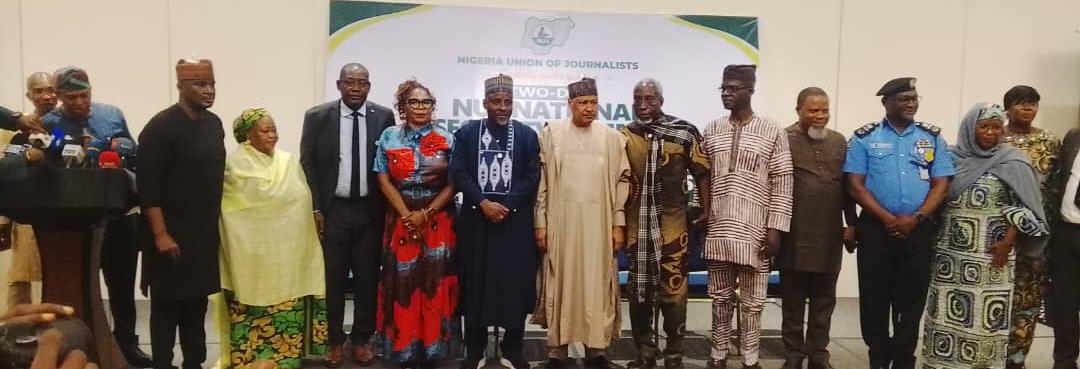
Present and past leaders of the Nigeria Union of Journalists (NUJ), alongside senior officials from key security agencies, have gathered in Abuja for a two-day National Security Summit.
The Summit aims to deepen collaboration, foster mutual trust, and chart practical strategies to strengthen the role of both the media and security institutions in advancing national unity and development.
In his address, Mohammed Idris, the Minister of Information and National Orientation, lauded the NUJ, DSS, and other security agencies for working together to promote media ideals and strengthen security in the country.He further noted that the theme “Media and Security Agencies as Partners in Nation Building” is timely, as both parties recently agreed to convene a meeting to fine-tune modalities for tackling the insecurity challenges bedeviling the nation.
The minister stated that the federal government has adopted a multidimensional and technology-driven approach to curtail rising insecurity.
He noted that both journalists and security agencies are established to serve a common goal, stressing that while the mandate of security agencies is to safeguard lives and property, the media serves as a watchdog to ensure accountability and transparency in governance.
“It is significant to see ourselves as promoters of peace, trust, and sincerity in order to foster national development. I urge the media to work ethically. The Federal Government considers security a priority and a fundamental pillar of President Bola Tinubu’s Renewed Hope Agenda. Journalists must do their job diligently. Even though we are in a critical situation, I remind you that the best editor is one who takes nation-building as his highest priority,” Idris said.
He further urged journalists to avoid giving prominence to criminal activities on their front pages.
The Minister of Information stressed that security is a collective and shared national responsibility.
“Let us use this platform to bring actionable recommendations that will help build a more secure and united Nigeria,” he added.
In his address NUJ National President, Comrade Alhassan Yahaya Abdullahi, described the gathering as “timely and significant,” noting that Nigeria continues to grapple with terrorism, banditry, kidnapping, cybercrime, misinformation and other emerging threats that demand collective action.
He stressed that the theme, “Media and Security Agencies as Partners in Nation Building,” underscores the fact that national security is not the sole responsibility of security agencies but a shared undertaking requiring the active participation of government, the media, civil society and citizens.
“The media and security institutions occupy strategic positions in every democratic society,” Abdullahi said. “While security agencies are entrusted with protecting lives, property and national sovereignty, the media serves as a critical bridge between government and the people through information dissemination, public enlightenment and accountability.”
The NUJ President expressed optimism that the summit would “strengthen trust, deepen mutual understanding and enhance cooperation in addressing our nation’s security challenges,” adding that the dialogue would help build stronger institutions and promote national unity.
The summit, jointly organised by the NUJ and the Department of State Services (DSS), features presentations and interactive sessions with security chiefs, policymakers, academics and media executives. A major highlight was a paper presentation by Professor Okey Okechukwu, Executive Director of Development SPECS Academy, on “The Media as Impact Multiplier in Military Operations and National Development.”
Abdullahi commended the Director-General of the DSS, Mr. Adeola Oluwatosin Ajayi, for his “exemplary leadership and unwavering commitment to fostering constructive engagement between the Service and the media,” noting that the partnership reflects a growing appreciation of the media’s role in nation building.
The NUJ President also acknowledged the presence of the Honourable Minister of Information and National Orientation, security chiefs, policymakers and development partners, describing their participation as a collective commitment to building a more secure and prosperous Nigeria
Speaking on behalf of the Kano state Governor, Abba Kabir Yusuf who is also the special guest at the event, the Commissioner of Information and Internal Affairs, Comrade Ibrahim Abdullahi Waiya said Kano State Government investing a lot of fund to enhance the practice of professional journalism as well as providing enabling environment for media practice in the state.
According to him further “Government registered 75 members of NIPR at once. 150 members of media practitioners have been registered in NBS, 90 members came from private sectors”
Speaking on the aspect of security the Governor said new security outfit Neighborhood Watch was established to enhance the the capacity of other security agencies.
He added that Kano Safe Corridor was lunched to curtail the issue of thuggery and other crimes among youths, 3,400 youths were employed under the safe Corridor.
He said the door of the ministry is always open for every journalist in the state.
He lauded leadership of NUJ for coming up with the initiative to foster good development.In a remark also the National Chairperson the Nigeria Association of Women Journalists (NAWOJ) Hajiya Aisha Ibrahim urged policymakers to recognize and strengthen the role of women in national security, peacebuilding, and social cohes
NAWOJ noted that while security debates often center on military operations and law enforcement, women’s contributions remain a critical but underutilized resource.
The association highlighted the influence women hold within families and communities as caregivers, educators, and mobilizers, noting that these roles provide “soft power” essential for instilling values of tolerance, patriotism, and peaceful coexistence in younger generations.
The group pointed out that women are frequently the first to detect early signs of radicalization, criminal tendencies, and social tensions within communities.
She added that their involvement in intelligence gathering, early warning systems, and grassroots peace initiatives, NAWOJ argued, can help prevent conflicts from escalating into national crises.
Drawing on global evidence, the National stressed that peace processes and security interventions are more effective and sustainable when women are included. NAWOJ outlined several recommendations, including greater inclusion of women in security decision-making, investment in women-led peacebuilding projects, engagement of women in community policing, and stronger support for female journalists covering security issues.
The also called for policies that empower women economically and socially, warning that poverty and exclusion often create conditions that fuel insecurity. “National security is not solely the responsibility of security agencies. It requires the active participation of families, communities, and institutions,” NAWOJ stated, reaffirming its commitment to promoting peace, responsible journalism, and women’s inclusion in Nigeria’s security agenda.
Add A Comment