

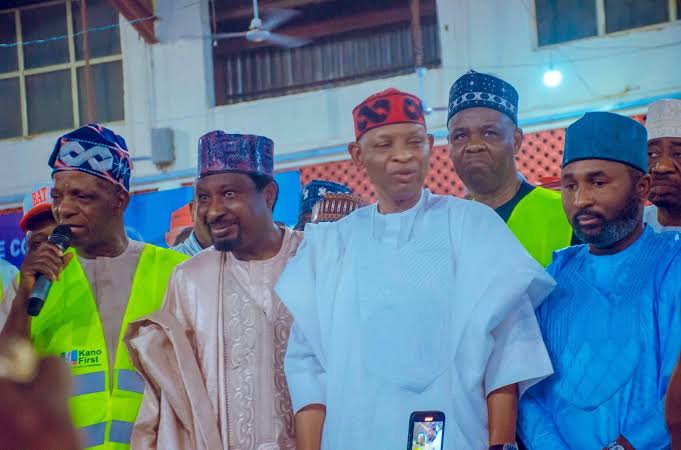
Jagoran Kano First, Kindly Hear Me Out: A Concerned Citizen’s Counsel To Governor Abba Kabir Yusuf As 2027 Approaches
By Sufyan Lawal Kabo
The most valuable counsel a leader can receive is rarely the most comfortable. It does not arrive wrapped in flattery or delivered through the careful diplomacy of those whose proximity to power has made honesty a professional risk. It comes, instead, from those who have no personal stake in the leader’s approval, whose only investment is in the success of the larger cause, and who understand, from the clear-eyed distance of genuine civic concern, what the leader’s inner circle is too close, too cautious, or too compromised to say plainly.
It is in that spirit, with deep and sincere respect for the leadership of Kano State and genuine appreciation for the efforts of His Excellency Governor Abba Kabir Yusuf, the Jagoran Kano First, that these reflections are offered. Not as an open letter, but as a general meditation on the political moment Kano finds itself in, so that everyone with a stake in the state’s future, governors and governed, appointees and ordinary citizens alike, can benefit from an honest reckoning with where we are and where we are headed.
The political landscape of Kano State has shifted dramatically in recent months. Governor Yusuf’s alignment with the All Progressives Congress has reconfigured the state’s political geometry in ways that are still working themselves out, generating new alliances, reopening old wounds, and producing the kind of charged political atmosphere in which the temptations of reactive communication are at their most dangerous and the need for strategic wisdom is at its most acute. A significant number of politicians have moved with the governor, drawn by conviction, by calculation, or by the simple pragmatism that has always characterized Kano’s political culture.
But the alignment has also generated intense opposition, particularly from within the Kwankwasiyya movement, whose supporters feel a sense of betrayal that is as emotionally powerful as it is politically consequential. As the 2027 elections approach, that opposition will not diminish. Every credible political analyst agrees that the coming contest between the Abba camp and the Kwankwasiyya will be among the most competitive and consequential Kano has seen in recent memory, quite possibly more intense than the earlier rivalry between the Kwankwasiyya and Gandujiyya camps.
The evidence of this intensifying contest is already visible in the digital public square. Social media comment sections beneath posts related to the governor’s activities have become battlegrounds of competing narratives, some constructive, many not. Critics deploy phrases like Falle Daya Ce, meaning one tenure only, with the rhythmic insistence of a political chant. The Kano First Agenda, championed with such intellectual seriousness by the Commissioner for Information and Internal Affairs, Comrade Ibrahim Abdullahi Waiya, widely and respectfully known as the Limamin Kano First, has been met with the sarcastic counter-phrase Kwano First, a deliberate attempt to trivialize a governing philosophy whose substance deserves engagement rather than mockery. These are the realities of a competitive democratic environment, and they demand a response. The question, and it is the most important political question facing the administration right now, is what kind of response.
The answer that too many supporters, aides, and communication officers around the governor have been providing is, to put it plainly, the wrong one. There is a pattern of engagement with critics and opposition voices that relies on emotional intensity where intellectual authority is required, on personal attacks where factual correction would be far more effective, and on the language of political combat where the language of governance achievement would be infinitely more persuasive. The public exchange between Dr Yusuf Kofar Mata, a former Commissioner for Higher Education and Science and Technology who departed after the political realignment, and Comrade Saidu Dakata of the Kano State Signage and Advertisement Agency, is instructive in this regard. Dakata’s approach, grounded in facts and delivered with composure, represents the model that every government communicator and supporter should study and emulate.
Dr Kofar Mata’s departure and subsequent criticism represent a pattern of political transition that is entirely normal in democratic politics, and the appropriate response to it is not personal hostility but the patient, evidence-based demonstration that the administration’s record speaks for itself.
This brings me to a point that I consider the most urgent communication lesson facing the Yusuf administration as it navigates the approach to 2027. The individuals who occupy communication roles around government do not speak only for themselves. They speak, whether they appreciate this or not, for the government they represent and for the governor whose vision they are entrusted to project. When their language is undignified, when their responses are emotional rather than evidential, when they mistake noise for effectiveness and aggression for strength, they do not merely embarrass themselves. They inflict reputational damage on the administration that no subsequent clarification can fully repair. A government spokesperson, a ministry official, a strategic appointee, these are not party supporters free to conduct themselves as partisans in a street argument. They are, in every public utterance, the voice of governance itself, and the standard to which that voice must be held is the standard of statesmanship, not political thuggery.
There is a deeper strategic error in the adversarial approach to opposition that I want to name directly, because it is one that has cost many Nigerian administrations dearly in the critical period before a contested election. Fighting the opposition, particularly a well-organized and emotionally motivated opposition like the Kwankwasiyya, does not weaken it. It energizes it. Every confrontation becomes a recruitment tool. Every insult directed at a critic generates sympathy among the undecided. Every demonstration of governmental arrogance reminds citizens who are watching carefully that power, when it forgets its purpose, becomes indistinguishable from the very thing it replaced. The comment sections and social media threads that carry intense opposition to the governor are not primarily problems to be suppressed.
They are political intelligence to be read, understood, and responded to with the kind of persuasive, patient, dignity-preserving engagement that converts skeptics into supporters rather than driving them deeper into the opposing camp.
History offers an instructive parallel that transcends cultural boundaries. When Liu Bang, the founder of the Han Dynasty, defeated the rival warlords who had contested the collapse of the Qin dynasty, he faced a choice that every leader in a contested political environment eventually faces: humiliate the defeated or absorb them. He chose absorption. He extended dignity and opportunity to former rivals, integrated their networks and constituencies into his growing coalition, and in doing so built a political foundation that sustained one of the most consequential dynasties in Chinese history. The lesson, ancient as it is, has lost none of its relevance. Strong leaders do not multiply enemies. They convert rivals into partners, or at the very minimum, they manage the relationship with former allies and current critics in ways that leave open the possibility of future reconciliation. The Quranic wisdom is equally direct and equally applicable: good and evil are not equal, and evil repelled with what is better produces a transformation that no amount of force or confrontation can achieve.
There is also a matter of democratic principle that deserves honest acknowledgement. From the moment a person is sworn in as governor, he ceases to be merely the leader of a political movement or the champion of a particular constituency. He becomes the governor of an entire state, responsible to every citizen within its boundaries regardless of how they voted, what party they support, or what they said about him during the campaign. The Kano First philosophy itself, in its most intellectually serious articulation, embodies this understanding. It insists that the interests of Kano must always take precedence over the interests of any party, any faction, or any individual. That principle cannot be selectively applied. It cannot mean Kano First when it is politically convenient and NNPP or APC first when political loyalties are under pressure. Its credibility depends entirely on its consistency, and its consistency depends on the willingness of the governor and everyone around him to hold themselves to the standard it sets, even when, especially when, it is politically costly to do so.
I want to address, with particular directness, the tendency among some government-aligned voices to disparage citizens and political figures who do not hold appointments, as though proximity to power were a measure of worth, wisdom, or loyalty. This is a dangerous and ultimately self-defeating attitude. Many of the individuals who supported this political movement through its most difficult years, who spent their own resources, sacrificed professional opportunities, and in some cases faced genuine personal risk because of their commitment to a cause, occupy no position today. The reasons for that are varied and are not, in most cases, a reflection of their competence or their loyalty. When those who have recently arrived at the table of power look down upon those who helped set it, they reveal not strength but insecurity, not confidence but the brittle arrogance of those who have confused the accident of appointment with the substance of achievement.
Kano politics has always been won through coalitions, through the patient assembly of diverse constituencies, interest groups, and political networks into a broad enough tent to command a democratic majority. The governor’s own political journey is a testament to this truth. His rise was built on the foundations of a movement that was itself a coalition, and the loyalty and hope of the people who believed in that movement were the currency with which his political capital was purchased. As 2027 approaches, the question is not whether opposition will intensify. It will.
The question is whether the administration will respond to that intensification with the wisdom, dignity, and strategic intelligence that the moment demands, expanding its coalition where it can, managing its critics with composure, and allowing the genuine achievements of the Kano First Agenda to make the most powerful argument that any government can make: the argument of visible, verifiable, citizen-felt results.
Our elders captured this wisdom with characteristic economy: Mai hikima gada yake ginawa ba bango ba. A wise person builds bridges, not walls. The administration of Governor Abba Kabir Yusuf has the vision, the intellectual resources, the policy framework, and the genuine achievements necessary to make a compelling case to the people of Kano. What it must also cultivate, with urgency and deliberate discipline, is the political maturity to pursue that case through persuasion rather than confrontation, through the steady demonstration of competence and integrity rather than the noisy prosecution of political rivalries. History remembers those who unified more fondly than those who divided. Kano deserves a government determined to be remembered well.
Sufyan Lawal Kabo is a political commentator and civic analyst based in Kano State.
Contact: sefjamil3@gmail.com