

By Abbas Ibrahim
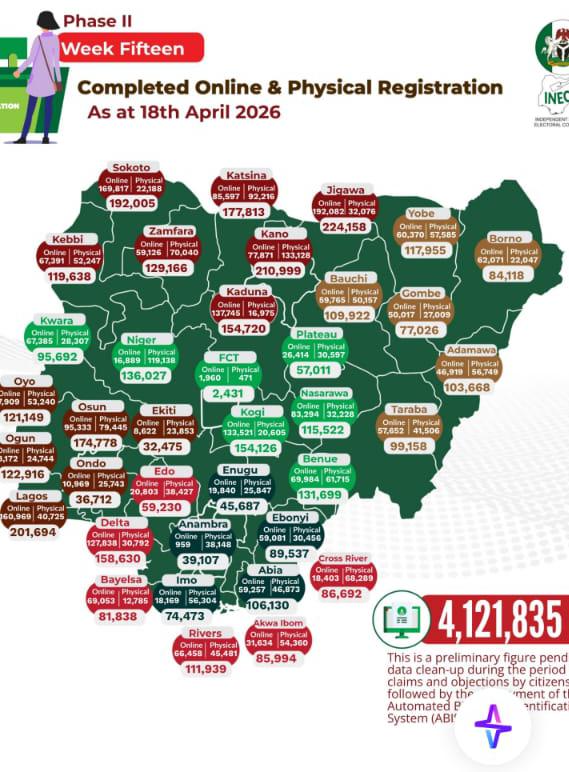
At the conclusion of the CVR second phase, Fresh data on nationwide registration has revealed strong grassroots participation across several states, with Kano State, Niger State and Katsina State emerging as top performers in physical registration.
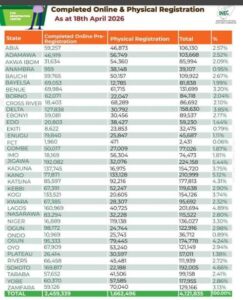
Out of a total of 4,121,835 registrants recorded across the country, 1,662,496 completed physical registration, underscoring the critical role of on ground mobilisation in the exercise.
Kano State led by a wide margin with 133,128 physically registered participants, consolidating its position as the highest contributor nationwide. It was followed by Niger State with 119,138 registrations, a remarkable feat given its relatively lower online pre-registration figures.
Katsina State ranked third with 92,216 physical registrations, while Osun State posted 79,445, reflecting strong conversion from online interest to physical turnout.
Other states in the top tier include Zamfara State (70,040), Cross River State (68,289), and Benue State (61,715), each demonstrating effective grassroots engagement strategies.
Further down the list, Yobe State recorded 57,585 registrations, closely followed by Adamawa State with 56,749 and Imo State with 56,304.
Analysts say the figures highlight a clear pattern: states with robust field mobilisation networks outperformed those that relied heavily on digital pre-registration. In several high performing states, physical registration figures significantly exceeded online pre-registration numbers, suggesting that in person outreach remains a decisive factor.
Conversely, some areas recorded comparatively low physical turnout. The Federal Capital Territory posted just 471 physical registrations, while Bayelsa State and Ondo State also trailed behind in on site participation.
The data points to widening disparities in access, awareness, and mobilisation capacity across states, raising questions about the balance between digital and physical engagement strategies in national exercises.
Stakeholders have called for increased investment in grassroots sensitisation and improved access to registration centres, particularly in underperforming areas, to ensure more inclusive participation in future exercises.
Overall, the strong showing in leading states reinforces the importance of physical presence and community level engagement in driving nationwide registration success.