

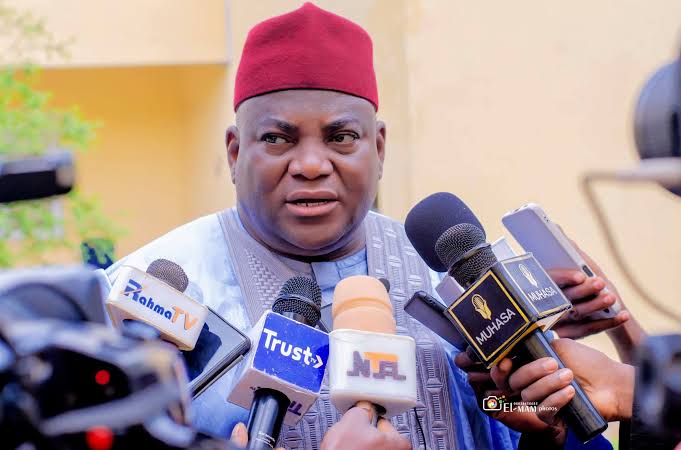
Comrade Ibrahim Waiya, Limamin Kano First: The Man Who Turned A Governor’s Vision Into A Governing Philosophy
By Sufyan Lawal Kano
The true measure of leadership has never been the grandeur of its proclamations. It has always been the discipline of its follow-through, the unglamorous, daily, often invisible work of converting a compelling vision into institutional reality, of ensuring that the ideas articulated in policy documents and public speeches actually reach the citizens whose lives they are intended to transform.
In Kano State today, that work is being done with a consistency and seriousness that deserves far wider recognition than it has so far received. And at the center of that effort, serving as both the strategic intelligence and the public conscience of the Kano First Agenda, stands the Honourable Commissioner for Information and Internal Affairs, Comrade Ibrahim Abdullahi Waiya, whose unofficial but deeply earned title, Limamin Kano First, speaks volumes about the nature and significance of his contribution.
The Kano First Initiative, conceived under the leadership of Governor Abba Kabir Yusuf as a governing philosophy that places the welfare, dignity, and progress of Kano’s citizens at the irreducible center of every policy decision, represents something genuinely distinctive in the landscape of Nigerian state governance. It is not merely a development agenda in the conventional sense, a list of projects to be completed and targets to be met. It is, at its most ambitious, an attempt to redefine the relationship between government and citizens, to move from a model of governance as service delivery toward a model of governance as shared civic enterprise, one in which citizens are not passive beneficiaries of government attention but active co-owners of the state’s development trajectory.
That is a profound ambition, and it requires, to become real, something that infrastructure projects and budget allocations alone cannot provide: a coherent, credible, and consistently communicated philosophy that citizens can understand, trust, and embrace as their own.
It is precisely here that Comrade Waiya’s contribution becomes indispensable. From the moment he assumed office, he brought to the Ministry of Information a clarity of purpose that distinguished his approach from the reactive, image-management orientation that has historically characterized government communication in this country. His mission, as he has articulated it through his public engagements, his institutional reforms, and his personal conduct, has been to build a communication architecture that serves not the government’s convenience but the citizens’ understanding.
That is a subtle but enormously consequential distinction, and it is one that has shaped every significant decision he has made since taking office.
Among his earliest and most consequential institutional actions was a systematic engagement with the state’s major government media organizations, including ARTV, Radio Kano, Triumph Publishing Company, and the Kano State Printing Press.
These engagements were not ceremonial visits. They were strategic assessments, aimed at understanding the capacity, the constraints, and the potential of the institutions through which government communicates with its citizens, and at beginning the process of revitalizing that machinery so that it could serve its proper democratic function: to inform, to educate, and to create the conditions for genuine public understanding of government policy. A government whose communication infrastructure is weak or dysfunctional cannot build the public trust that effective governance requires, regardless of the quality of its policies. Waiya understood this, and he acted on it.
Equally significant was his investment in human capacity at the grassroots level.
The decision to organize training programs for information officers from all forty-four local government areas of Kano State reflected an understanding that strategic communication cannot be confined to the state capital or to the national media. It must penetrate to the ward level, to the market and the mosque and the community meeting, to the spaces where the overwhelming majority of Kano’s citizens actually encounter government and form their judgments about its intentions and its performance.
By building a stronger grassroots communication network, Waiya created the infrastructure for the kind of citizen-level engagement that the Kano First philosophy demands but that no amount of press releases or social media content can substitute for.
His engagement with the media profession itself has been another dimension of his work that deserves particular recognition. Recognizing that the quality of public discourse in Kano is inseparable from the quality of its journalism, Waiya has invested consistently in building relationships with journalists, broadcasters, and communication professionals, not to manage their coverage or to cultivate favorable reporting, but to foster the kind of professional standards and development-oriented journalism that a society serious about its own progress requires.
His consistent message to media practitioners, that responsible, accurate, and constructive reporting is not merely a professional obligation but a civic contribution, reflects a sophisticated understanding of the media’s role in either deepening or undermining public trust in institutions.
Perhaps the most important philosophical contribution Waiya has made to the Kano First discourse, however, is his insistence that popularizing the agenda is not a political act but a civic duty. This reframing is, in the context of Nigerian political culture, genuinely radical. In a political environment where almost every public initiative is immediately read through a partisan lens, where support for a government programme is routinely interpreted as political allegiance and skepticism as opposition, the assertion that the Kano First Agenda belongs not to the political party or to the Yusuf administration but to the people of Kano is a claim that cuts across the grain of established political behavior. It is also, if it can be made to stick, extraordinarily powerful, because a civic philosophy that transcends partisan boundaries is one that can survive electoral cycles and accumulate the kind of broad, durable public support that transforms individual administrations’ programmes into lasting institutional culture.The evidence that this reframing is beginning to take hold is visible, if not yet definitive.
Citizens across the state are demonstrably more informed about the administration’s policies and the philosophy that underpins them. Public conversations about development are increasingly framed in the language of collective responsibility and civic ownership rather than purely in terms of government performance and political judgment.
Community leaders, professional associations, civil society organizations, and youth groups are engaging with the Kano First framework in ways that suggest a growing recognition that the initiative speaks to something real in the shared aspirations of Kano’s people, something that predates the current administration and will, if properly nurtured, outlast it.
None of this diminishes the central role of Governor Abba Kabir Yusuf, whose personal commitment to the Kano First philosophy provides the political authority and executive backing without which no communication strategy, however brilliant, can translate vision into action. The governor’s record of progress across infrastructure development, education, healthcare, youth empowerment, and social welfare initiatives is the material foundation on which the Kano First narrative is built. Without that foundation, the most skillful communication would eventually ring hollow. With it, skillful communication becomes the bridge between government achievement and public understanding, between what is being done and what citizens know and believe about what is being done. That bridge is what Waiya has been building, patiently, consistently, and with considerable skill, since the first day he took office.
What observers of his ministry most frequently note is not any single achievement but a quality of presence and commitment that is, in Nigerian public life, genuinely unusual. Waiya engages, consistently and seriously, with the full range of stakeholders whose participation the Kano First philosophy requires: journalists and community leaders, professional bodies and civil society organizations, youth groups and traditional institutions, media practitioners and policy analysts. He does not manage these relationships from a distance or through intermediaries. He shows up, he listens, he explains, and he follows through. That combination of intellectual seriousness and personal accessibility is, in the world of governance communication, a rare and valuable combination, and it is one that has earned him a reputation that no amount of political positioning could manufacture.
As Kano State continues to navigate the complex terrain of development, democratic consolidation, and social renewal, the work of the Limamin Kano First remains as urgent as it has ever been. The Kano First Initiative is still in its formative stages. Its ultimate success will depend on the quality of its implementation, the consistency of its leadership, and above all, the willingness of Kano’s citizens to claim it as their own rather than leaving it to government alone.
Comrade Ibrahim Abdullahi Waiya has done the foundational work of making that claim possible. He has given the governor’s vision an intellectual architecture, a communication infrastructure, and a civic philosophy robust enough to withstand the pressures of a complex political environment. The rest, as it must always be in a genuine democracy, belongs to the people.
Sufyan Lawal Kano is a public affairs writer and civic commentator based in Kano State.
Contact: sefjamil3@gmail.com