

KACHMA: Is Kano Contributory “Healthcare Relief Program” Turning Into A Burden For Enrollees?
By Abbas Ibrahim with Contributions from Abdullahi Yusuf, Muhammad Kabir Ya’u, Mustapha Muhammad, Kabiru Basiru Fulatan and Salisu Ibrahim
Kano State Health Contributory Scheme set up as a classic bridge to better health for all. However, access to its services that is expected to open doors for the vulnerable, is becoming herculean.
Investigation by Checks Naija revealed that the scheme is undergoing some “administrative hiccups”, making its services difficult to access.
Apparently as a well intentioned Program aimed at easing health challenges for participants, the Scheme is passing through too many toll booths, making people to stop trying to access the services, as the Scheme is gradually losing steam, our correspondents gathered.
Checks Naija reported how the scheme due to, some “Administrative flaws”, becomes stressful to enrollees and the complexity gap is also making the program shift from becoming a lifeline to a burden for the enrollees
For 41-year-old Hafsat, a housewife and mother of four living with asthma, access to healthcare under the Kano Contributory Health Scheme was supposed to bring relief.
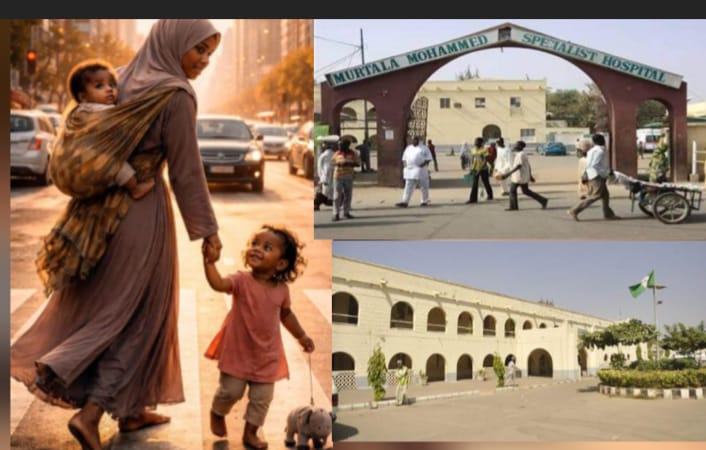
Enrolled through her husband, a civil servant, she receives care at Murtala Muhammad Specialist Hospital,one of the state’s busiest referral facilities serving thousands across Kano and neighboring states.
But instead of relief, Hafsat’s experience has become a daily struggle.
Each clinic visit presents a daunting challenge. Often accompanied by her two youngest children, one strapped to her back and the other in tow, she must cross a busy road to obtain prescribed medications from a designated pharmacy located outside the outpatient department where she receives care.
The journey is not just exhausting; it is dangerous, the patient stressed.
“The stress alone can trigger my asthma,” she says.
Despite her fragile condition, Hafsat is required to physically present herself at the pharmacy after consultations, even when visibly weak. Over time, the burden became unbearable.
“At some point, I asked myself, what is the point? The stress of getting the drugs defeats the purpose of the treatment,” she lamented.
Eventually, she opted out of the scheme’s process entirely, choosing instead to buy her medications from a nearby private pharmacy at a higher personal cost.
Hafsat’s story is not an isolated case.
Investigations by Checks Naija reveal that many enrollees, particularly the elderly and other vulnerable groups have quietly abandoned the system due to similar difficulties. Ironically, pharmacies not affiliated with the Kano Contributory Health Management Agency (KACHMA) operate within the same outpatient premises where patients receive care, raising serious concerns about accessibility and system design.
With an estimated 25,000 to 30,000 enrollees attached to the facility, the hospital reportedly receives N10,000,000 to N12,000,000( Ten Million to Twelve Million Naira ) monthly capitation, N400 per enrolee under the scheme. Yet, the structure of service delivery appears misaligned with the realities and needs of patients.
This disconnect raises troubling questions: Why must beneficiaries travel longer distances for medication when closer alternatives exist? Is this a case of administrative oversight, systemic inefficiency, or something more deliberate?
Further findings suggest that internal logistical inconsistencies within government circles may be contributing to the operational gaps affecting patient care.
For a programme designed to reduce hardship, many patients are instead left to endure avoidable suffering.
Beyond inconvenience, the situation raises constitutional concerns. Section 17(3)(d) of the Constitution of the Federal Republic of Nigeria clearly states:
“The State shall direct its policy towards ensuring that there are adequate medical and health facilities for all persons.”
Can a system that forces sick, weak, and vulnerable patients to cross busy roads in search of medication truly be described as providing “adequate” healthcare access?
Checks Naija formally sought clarification from the Kano State Health Management Board through its Public Relations Unit, directing questions to the Executive Secretary, Dr. Nagoda, as far back as March 11, 2026. The inquiries focused on the rationale behind the physical separation of the outpatient department and pharmacy, the risks posed to patients, and the lack of flexibility such as allowing proxies to collect medications on behalf of the critically ill.
Weeks later, no official response has been provided, although the public Relations Officer, Samira Suleiman gave health concerns and bereavement as reasons for the silence. A week later,the silence persists.
At a time when citizens increasingly rely on contributory health schemes for survival, inefficiencies such as these risk erodes trust in the system and defeating its core objective.
There is now a growing call for urgent government intervention.
Beneficiaries argued that only decisive action from Governor Abba Kabir Yusuf can address the systemic lapses, and restore confidence in the scheme. Practical steps such as integrating pharmacy services within outpatient departments, allowing proxy drug collection for vulnerable patients, and improving coordination between service units could significantly ease the burden on enrollees.
For Hafsat and others like her, the solution cannot come soon enough.
Healthcare, after all, should heal not harm.
Our concern is that, officials running this program often forget the emotional labor patients pass through. When a system is designed with a “gatekeeper” mentality—treating every applicant like a potential fraudster—it creates a psychological burden, a beneficiary Muhammad Bello told Checks Naija.
According to him, “a system that was designed to be ‘rigorous’ to prevent abuse often becomes so dehumanizing that those who need it most opt out to preserve their dignity.”
Investigations by Checks Naija also revealed that many enrollees, particularly the elderly and other vulnerable groups have quietly abandoned the system due to similar difficulties. Ironically, pharmacies not affiliated with the Kano Contributory Health Management Agency (KACHMA) operate within the same outpatient premises where patients receive care, raising serious concerns about accessibility and system design.
With an estimated 25,000 to 30,000 enrollees attached to the facility, the hospital reportedly receives N10,000,000 to N12,000,000( Ten Million to Twelve Million Naira ) monthly capitation, N400 per enrolee under the scheme. Yet, the structure of service delivery appears misaligned with the realities and needs of patients.
This disconnect raises troubling questions: Why must beneficiaries travel longer distances for medication when closer alternatives exist? Is this a case of administrative oversight, systemic inefficiency, or something more deliberate?
Further findings suggest that internal logistical inconsistencies within government circles may be contributing to the operational gaps affecting patient care.
For a programme designed to reduce hardship, many patients are instead left to endure avoidable suffering.
Beyond inconvenience, the situation raises constitutional concerns. Section 17(3)(d) of the Constitution of the Federal Republic of Nigeria clearly states:
“The State shall direct its policy towards ensuring that there are adequate medical and health facilities for all persons.”
Can a system that forces sick, weak, and vulnerable patients to cross busy roads in search of medication truly be described as providing “adequate” healthcare access?
Checks Naija formally sought clarification from the Kano State Health Management Board through its Public Relations Unit, directing questions to the Executive Secretary, Dr. Nagoda, as far back as March 11, 2026.
The inquiries focused on the rationale behind the physical separation of the outpatient department and pharmacy, the risks posed to patients, and the lack of flexibility such as allowing proxies to collect medications on behalf of the critically ill.
Weeks later, no official response has been provided, although the public Relations Officer, Samira Suleiman gave health concerns and bereavement as reasons for the silence. A week later,the silence persists.
At a time when citizens increasingly rely on contributory health schemes for survival, inefficiencies such as these risk erodes trust in the system and defeating its core objective.
There is now a growing call for urgent government intervention.
Observers argue that only decisive action from Governor Abba Kabir Yusuf can address the systemic lapses, and restore confidence in the scheme. Practical steps such as integrating pharmacy services within outpatient departments, allowing proxy drug collection for vulnerable patients, and improving coordination between service units could significantly ease the burden on enrollees.
For Hafsat and others like her, the solution cannot come soon enough.
Healthcare, after all, should heal not harm.
Checks Naija reports that when the cost of getting help—whether measured in time, or stress, —exceeds the value of the help itself, the program has ceased to be a service and has become a barrier.