

Kano First: Governor Abba Kabir Yusuf’s Vision For People-Centered Governance
By Abdu Saidu
Across the long and complicated history of Nigerian governance, the distance between a governor’s stated vision and the lived reality of the citizens that vision was supposed to serve has been, with depressing consistency, vast. Manifestos have been written with eloquence and abandoned with ease. Slogans have been coined with creativity and hollowed out with indifference.
The political vocabulary of people-centered governance, of putting citizens first, of development rooted in the needs and aspirations of ordinary men and women, has been deployed so frequently and so cynically by successive administrations that it has, in many parts of the country, lost the capacity to inspire the very people it was designed to mobilize. Against this backdrop of accumulated disappointment, the emergence of the Kano First philosophy under Governor Abba Kabir Yusuf demands to be assessed not merely on the strength of its language, considerable as that is, but on the seriousness of its institutional grounding, the coherence of its intellectual architecture, and the evidence, however early and partial, of its translation into actual governance practice.
What distinguishes the Kano First Initiative from the generality of Nigerian state governance slogans is precisely that it has refused to remain merely a slogan. From the outset of his administration, Governor Yusuf has demonstrated, through the decisions he has made and the priorities he has set, that Kano First is not a campaign device that outlived its electoral usefulness, but a genuine governing philosophy, one that asks a deceptively simple but profoundly demanding question of every policy decision, every budget allocation, every institutional appointment, and every programmatic commitment: does this put Kano and its people first? It is a question that, if asked honestly and answered consistently, has the power to transform not just individual policies but the entire culture of an administration, reorienting the default instincts of government away from the interests of the politically connected and toward the needs of the ordinarily forgotten.
The philosophical foundation of the initiative is worth examining carefully, because it is more intellectually serious than casual observers have recognized. The Kano First framework is not built on the vague populism that characterizes so much of Nigerian political communication. It is anchored in a specific and historically grounded understanding of what Kano is, what it has been, and what it has the potential to become. Kano’s civilizational heritage, built over centuries on the mutually reinforcing pillars of Islamic ethical governance, commercial integrity, agricultural productivity, artisan excellence, and legitimate traditional authority, represents a development logic that was not imported or imposed but organically cultivated by successive generations of Kano’s people.
The Kano First philosophy draws deliberately on this heritage, proposing not a break from Kano’s past but a return to its deepest values, values of integrity, communal responsibility, productive enterprise, and the subordination of personal interest to collective wellbeing.
This historical grounding gives the initiative a cultural legitimacy that purely technocratic governance frameworks cannot achieve. When Governor Yusuf speaks of placing Kano’s interests at the center of governance, he is not articulating a novel political idea. He is, in a very real sense, calling Kano back to itself, reminding its institutions and its citizens of a governing tradition that predates the distortions of recent decades and that contains within it the resources necessary for genuine renewal. That is a powerful message, and it is one that resonates in ways that development metrics and infrastructure targets alone cannot replicate, because it speaks not just to what Kano needs but to who Kano is.
The practical expression of this philosophy across the administration’s policy agenda has been visible in its emphasis on education, infrastructure, healthcare delivery, youth empowerment, and social welfare, not as isolated sectoral interventions but as interconnected dimensions of a single, coherent commitment to improving the quality of life of Kano’s citizens. What is most significant about this approach is not any individual programme or project, important as those are, but the governing logic that connects them: the insistence that public resources exist to serve public needs, that government institutions derive their legitimacy from the quality of their service to citizens, and that the measure of an administration’s success is ultimately not what it has built but how it has changed the lived experience of the people it was elected to serve.
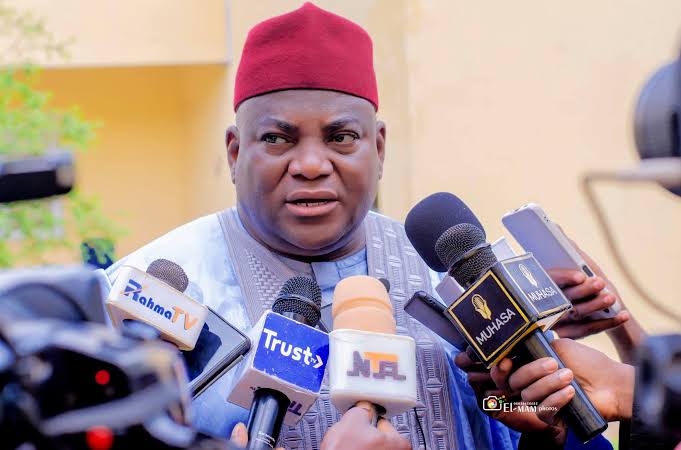
Central to the administration’s ability to communicate this philosophy with the clarity and consistency it requires has been the strategic contribution of the Honourable Commissioner for Information and Internal Affairs, Comrade Ibrahim Abdullahi Waiya, whose role in translating the governor’s vision into a coherent and publicly accessible governance narrative has been as indispensable as it has been intellectually serious.
Waiya arrived at the ministry not as a conventional government spokesman but as a thinker and strategist with a formed view of what government communication in a genuinely democratic society must achieve. His foundational conviction, that the Ministry of Information exists not to manage the government’s image but to cultivate the citizens’ understanding, has shaped every significant decision of his tenure and has given the administration’s public communication a quality of intellectual seriousness that distinguishes it sharply from the reactive, defensive, and frequently dishonest communication that characterizes too many Nigerian state governments.
Under his leadership, the Ministry of Information has intensified and deepened its engagement across the full spectrum of Kano’s communication landscape, from the major state media organizations whose institutional capacity he has worked systematically to revitalize, to the grassroots information networks whose reach into Kano’s communities no national platform can replicate, to the professional media bodies and civil society organizations whose credibility and independence make them essential partners in the project of building genuine public understanding of government policy. The training of information officers across all forty-four local government areas of the state was not a routine bureaucratic exercise. It was a deliberate investment in the communication infrastructure that a people-centered governance philosophy requires if its principles are to travel beyond the walls of government ministries and into the daily conversations of the citizens those principles are designed to serve.
The Kano First Initiative’s insistence on transparency and public engagement as governance instruments rather than communication strategies is, in this context, more than rhetorical. It reflects a genuine understanding, shared by both the governor and his commissioner for information, that trust between government and citizens is not a given in any society that has experienced the levels of institutional betrayal that Kano has endured in recent decades. Trust must be rebuilt, slowly, consistently, and through the kind of alignment between words and deeds that cannot be manufactured by any communication campaign, however sophisticated. Every time the administration makes a decision that demonstrably prioritizes citizens over political convenience, every time it communicates that decision honestly and completely, and every time it follows through on a commitment it has made publicly, it adds a small but real deposit to the account of public trust that the Kano First philosophy ultimately depends upon.
It would be both intellectually dishonest and strategically counterproductive to pretend that this work is complete or that the challenges ahead are not formidable. Kano is a large, complex, and rapidly changing society whose development needs are enormous and whose resources, as in every Nigerian state, are constrained by structural realities that no single administration can resolve on its own. The behavioral and normative dimensions of the Kano First agenda, the attempt to reshape civic culture, rebuild institutional trust, and reorient the aspirations of a young and underserved population toward productive enterprise and collective responsibility, are generational projects that will require sustained commitment well beyond any single electoral cycle. The administration’s willingness to acknowledge these challenges openly, rather than projecting an image of effortless success, is itself a demonstration of the governing philosophy it champions.
What the people of Kano, and the broader Nigerian public, are witnessing in the Kano First Initiative is something genuinely worth paying attention to: a state government that has staked its legacy not on the volume of its projects or the scale of its announcements, but on the seriousness of its commitment to a governing idea.
Governor Abba Kabir Yusuf has bet his administration’s historical reputation on the proposition that governance rooted in the genuine interests of citizens, communicated with honesty and intellectual seriousness, and implemented with the kind of institutional discipline that the Kano First framework demands, can produce something more durable and more meaningful than the conventional Nigerian gubernatorial legacy of roads, buildings, and ribbon-cutting ceremonies. It is an audacious bet. And for Kano’s sake, it is one that deserves every support that informed citizens, responsible media, and committed institutions can give it.
Abdu Saidu is a governance and public affairs analyst based in Kano State.