

Jigawa at 34: The Poetry of Progress, the Philosophy of Responsibility
By Lamara Garba Azare
Thirty-four years in the life of a state is like a river carving its way through rocks; steady, patient, sometimes turbulent, yet always forward. Jigawa, born on that fateful Tuesday, 27th August 1991, out of Kano’s map and skepticism, was once dismissed as barren land with little hope of survival. Some mocked it as a mere “civil service state,” others doubted whether it could pay salaries, let alone build an economy. Yet, as the calendar marks 34 years, the story has changed. Jigawa has risen with quiet resilience to become one of the most peaceful and administratively stable states in Nigeria.
The early years were defined by scarcity. The first military administrator, Colonel Olayinka Sule, is remembered for lamenting that he inherited “only one brick house.” That statement captured the reality of Jigawa’s beginning: a state without structures, institutions, or resources. Roads were scarce, schools too few, and hospitals barely functional. Yet the people endured, and leaders improvised. Colonel Ibrahim Aliyu, who followed, set in motion the first structures of governance, laying the foundation of ministries and local councils. To many, those years felt like planting seeds in dry ground, but they were necessary steps in the long journey of becoming.
With the return of civilian rule in 1999, Ibrahim Saminu Turaki stepped in as the first elected governor. His administration invested in fiscal reforms, introducing measures to expand internally generated revenue and experiment with new public-private partnerships. Though his tenure was not without controversies, he carved out a fiscal pathway that reduced the dependency on federal allocation. After him came Sule Lamido, whose eight years brought a new sense of pride to Jigawa. Lamido, influenced by his socialist leaning, embarked on massive infrastructural transformation—roads, schools, hospitals, and housing projects. He established the Jigawa State University at Kafin Hausa, expanded Dutse Airport, and made the capital a hub of activity. He also became known for his reforms in public service, branding Jigawa as one of the few states with relative transparency in public finance.
After Lamido came Muhammad Badaru Abubakar, fondly called “Baba Mai Calculator.” His tenure emphasized prudence, continuity, and rural development. He is remembered for expanding road projects, completing water schemes, and paying attention to agricultural reforms. Under him, Jigawa consolidated its reputation as a state that avoided reckless borrowing and maintained financial discipline. His eight years were defined by calm governance, with Jigawa standing out in a country often shaken by political turbulence.
Today, Governor Umar A. Namadi continues from where his predecessors stopped. At the 34th anniversary celebration, he spoke with both gratitude and resolve. He reminded his audience that Jigawa’s story is not about individuals but about a people who endured hardship, believed in progress, and built a state from near-nothing. “With profound gratitude to Allah SWT,” he said, “I am delighted to stand among our past leaders and our people on this historic day. From the bereft position of 1991, Jigawa has come of age. It has not been a smooth journey, but an arduous one marked by sacrifice, resilience, and disciplined leadership.” His words carried the weight of history as he acknowledged the contributions of his predecessors—military and civilian alike—and framed his administration as another link in the chain of continuity.
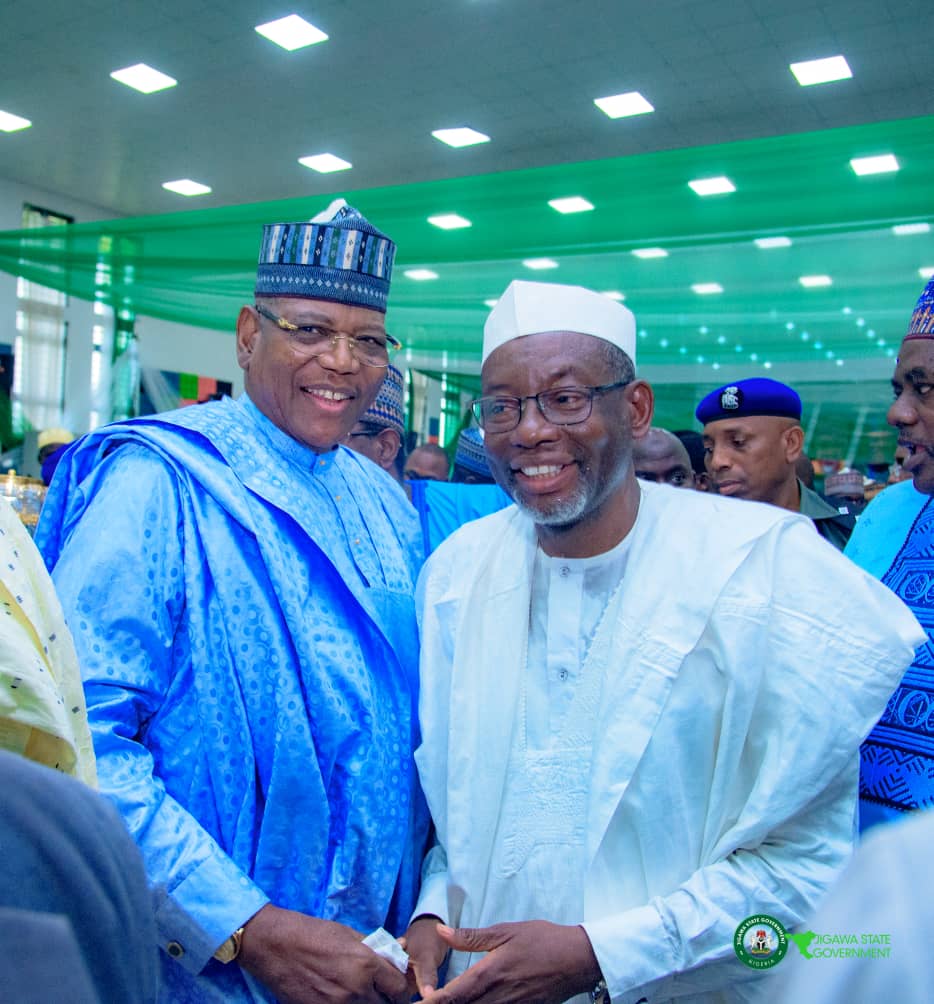
On Wednesday, 27th August 2025, the State capital, Dutse, became a theatre of gratitude and reflection. Past governors, elder statesmen, traditional rulers, academicians, and citizens converged not merely to celebrate a date, but to affirm the philosophy of unity—that leadership, in its truest form, is a relay where each handoff builds a greater tomorrow. The Shekoni, in words that carried both humility and grandeur, captured the essence of the day when he declared:
“With profound gratitude to Allah SWT, I am highly delighted for having the privilege of being in the midst of all the highly notable individuals here present, who have greatly contributed to the making of our dear State of Jigawa. In particular, I am truly highly honoured and humbled by the presence of all the past leaders that have found time to be with us here today to grace this auspicious and memorable occasion of the 34th Anniversary of the Creation of Jigawa State. We most profoundly thank Allah SWT, by Whose grace, mercy and benevolence, you are all opportune to be with us here today to mark the occasion.”
His words reminded the gathering that Jigawa is not the achievement of one man or one government but a collective labour of leaders, elites, and citizens alike. In a moment that stilled the hall, the Emir of Dutse rose to speak. His voice, calm and regal, carried the authority of history and the warmth of a father blessing his children. He said, “My dear people of Jigawa, today is not just about celebrating years; it is about celebrating patience, vision, and unity. When this State was created, many doubted its survival. But see where we stand today thriving, dignified, respected. This is the fruit of discipline, of faith in Allah, and of leaders who placed service above self. As we mark 34 years, let us remember that development is not only about roads, hospitals, and schools. It is also about the moral fibre of our people, the dignity of our youth, the empowerment of our women, and the protection of our traditions. Let us continue to live as one family, bound by faith, guided by wisdom, and inspired by hope. For the future of Jigawa is not in the hands of a few—it is in the hands of all.”
His message resonated deeply: that progress is incomplete without unity and moral strength, and that Jigawa’s greatness lies in its people as much as in its infrastructure. To balance tradition with intellect, Professor Ruqayyatu Ahmed Rufai, former Minister of Education and one of Jigawa’s most distinguished daughters, offered her reflection. With the elegance of scholarship and the passion of a patriot, she declared, “As we celebrate Jigawa at 34, let us not only recount the legacies of our leaders but also measure how far we have come in nurturing the minds of our children. Education has always been the ladder out of poverty, the torch that lights the path of progress. I am proud that Jigawa has invested in this sacred sector, but I must urge that we do more. Our girls must be given the wings to fly, our boys the skills to create, and our teachers the honour they deserve. For it is only through knowledge, discipline, and values that the dream of Greater Jigawa will find permanence. Let us ensure that no child in this land is left behind in the march towards development. That, for me, will be the greatest legacy of our 34 years.”
Her words cast a prophetic challenge to the State: that physical structures will one day fade, but education remains an immortal gift that shapes destinies across generations. Together, the speeches of the Shekoni, the Emir of Dutse, and Professor Rufai wove a tapestry of perspectives: governance, tradition, and scholarship. It was a reminder that true progress requires the harmony of all pillars of society.
Namadi then turned to the present, outlining his efforts under the 12-Point Agenda for Greater Jigawa. Barely two years in office, he has overseen the completion of over 300 km of inherited roads with another 800 km under construction, embarked on a 600-unit housing scheme with hundreds already completed, and pushed forward the long-awaited Dutse Water Project. His government has launched erosion and flood mitigation projects to reclaim degraded lands, empowered over 300,000 youths and women through job creation programmes, and established new agencies to modernize agriculture and livestock production. “These are not just projects,” he declared, “they are building blocks for a greater Jigawa.”
But even in celebration, the challenges were not ignored. Jigawa still struggles with out-of-school children, with youth in search of jobs, and with the slow pace of industrialization. Poverty, though reduced, still casts a shadow across many families. At 34, the state stands at a crossroad. Its achievements prove that steady governance can make a difference, but the next chapter will depend on how leaders confront the deeper questions of education, employment, and industrial growth.
The story of Jigawa is the story of unity across political divides, across time, and across visions. It is the story of resilience, of leaders who built not for themselves but for a people, and of citizens who have borne sacrifices with patience. The anniversary, however, was not just a look backwards; it was a gaze forward.
As the Emir reminded, unity and morality must remain the compass. As Professor Rufai urged, education must remain the ladder. And as the Shekoni prayed, faith must remain the anchor. Jigawa at 34 is not just a celebration of years; it is a philosophy of progress. It is the poetry of resilience. It is the reminder that from barren soil can grow a garden if nurtured with patience, vision, and faith. Undeniably, thirty-four years on, Jigawa teaches Nigeria a lesson: that from barren soil, a garden can bloom if watered by discipline, faith, and unity of purpose.
Lamara Garba Azare, writes from Kano