

Tinubu’s Umrah: Beyond Politics, A Journey Of Faith And National Prayers
By Muhammad Garba
In Islam, Umrah, commonly known as the Lesser Hajj, occupies an important place as an act of worship and spiritual devotion. Although it is not compulsory in the same way as Hajj, it is a highly rewarding pilgrimage that can be undertaken at any time of the year. It offers believers an opportunity to renew their faith, seek forgiveness, express gratitude to Almighty Allah and pray for divine guidance and blessings.
The journey to Makkah is, therefore, more than a physical undertaking. It is an opportunity for spiritual reflection, humility and submission to the will of Almighty Allah. For many Muslims, performing Umrah is a deeply cherished experience, particularly, because of the opportunity to offer personal supplications at Islam’s holiest sites.
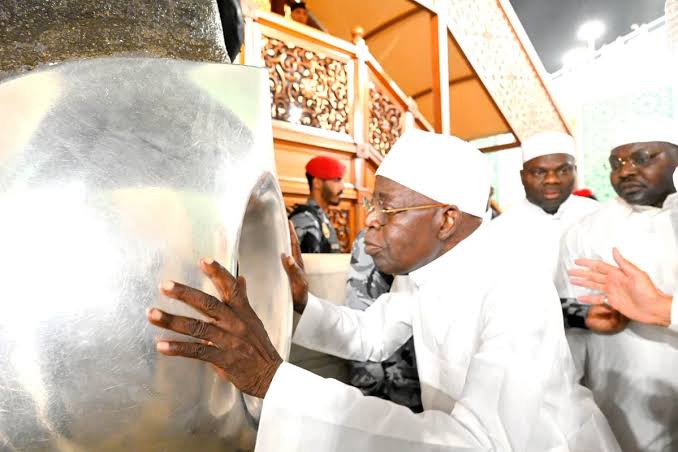
It was against this spiritual background that President Bola Ahmed Tinubu undertook his recent journey to Makkah, Saudi Arabia, to perform Umrah. Beyond the spiritual fulfilment of the pilgrimage, the President used the opportunity to pray for Nigeria’s peace, unity, stability and prosperity.
At a time when countries across the world, including Nigeria, are grappling with significant economic, security and political challenges, governments are pursuing various measures to address these concerns. Against this background, the President’s decision to seek divine guidance and offer prayers for the country is worthy of reflection.
Unfortunately, what should ordinarily be a personal religious experience has attracted considerable political commentary, including from former Vice President Atiku Abubakar, the presidential candidate of the opposition African Democratic Congress (ADC).
Atiku’s demand for regular, date-stamped photographs and videos of the President’s movements in the Holy Land has generated discussions about the appropriate boundaries between public accountability and personal religious obligations. But in his wisdom, President Tinubu gave express approval for undiluted media scrutiny and coverage of his activutues in the Holy Land.
There is no doubt that the President, like every other public office holder, is accountable to Nigerians. His policies, decisions and performance in office are legitimate subjects of public scrutiny. However, there should also be a distinction between holding a government accountable and subjecting a personal spiritual journey to unnecessary political controversy.
Religion is a sensitive and deeply personal matter. In a religiously diverse country such as Nigeria, political leaders should demonstrate restraint and mutual respect when commenting on the faith and religious practices of others. Political disagreements should not become an excuse to politicise religious obligations or diminish their spiritual significance.
President Tinubu, on his part, maintained a largely spiritual focus throughout the pilgrimage. He used the opportunity to pray for Nigeria, seeking divine intervention for peace, national harmony, stability and prosperity. He also expressed the hope that the 2027 general election would be conducted peacefully, without violence or unnecessary tension.
His prayers for Nigeria, irrespective of political affiliations, are an expression of goodwill that should resonate with all citizens. While political parties may have different visions and aspirations for the country, the desire for peaceful elections and national stability should be a shared responsibility.
One of the most remarkable moments of the President’s visit was the rare privilege extended to him and members of his delegation to enter the interior of the Holy Kaaba and offer prayers. The Kaaba, located within the Grand Mosque in Makkah, is the most sacred structure in Islam, and access to its interior is highly restricted.
This is not a normal Umrah. The President went Oct 30, performed Umrah early Oct 31, and on Nov 1 was granted entry inside the Holy Ka’aba. Access to the interior of the Ka’aba is not part of Umrah or Hajj. It is opened only a few times a year, by order of the Saudi Royal Court, for Heads of State and monarchs. Tinubu entered, prayed inside, and kissed the Black Stone (Hajar al-Aswad). It was his first time inside, though he has performed Umrah and Hajj many times before. He said it fulfilled a vow he made before the 2023 election – that if he won, he would return to thank Allah. His prayer inside: “I asked for wisdom and resilience to continue to serve the people. And I know that prayer has been granted.”
The opportunity represents an extraordinary spiritual privilege, one that very few people are afforded. President Tinubu expressed gratitude to the Saudi leadership for the honour, particularly, the Custodian of the Two Holy Mosques, King Salman bin Abdulaziz Al Saud, and Crown Prince Mohammed bin Salman.
Beyond its spiritual significance, the gesture also reflects the cordial relationship between Nigeria and Saudi Arabia, strengthened by longstanding religious, diplomatic and bilateral ties.
Another aspect of the pilgrimage that deserves attention is the President’s participation in the physical rites of Umrah. The exercise involves Tawaf, the circumambulation of the Kaaba seven times, and Sa’i, the movement between the hills of Safa and Marwa, which commemorates the experience of Hajar, the wife of Prophet Ibrahim (AS). These rites require physical effort and endurance.
President Tinubu actively participated in these activities. This is noteworthy against the background of recurring public speculation about his health and physical capacity. The images and videos from Makkah provide a public account of his participation in the religious exercise and should be considered in discussions about his physical engagement in the pilgrimage, rather than allowing speculation to take the place of observable facts.
There is also another dimension to the discussion. Some commentators have gone beyond questions about the President’s health to cast doubts on his religious devotion and ability to perform Islamic religious obligations. Such insinuations are unnecessary, particularly because religious faith is a personal matter that deserves respect.
During his stay in Makkah, the President also led members of his delegation in a congregational Maghrib prayer. The significance of this should not be overlooked. Maghrib is one of the five daily obligatory prayers in Islam, during which the Imam recites portions of the Glorious Qur’an aloud in the first two units of prayer. The President’s participation in leading the congregation was another public demonstration of his engagement with the religious observances of his faith.
Political differences should not become a basis for questioning or disparaging an individual’s personal relationship with religion. Nigerians are entitled to disagree with President Tinubu politically, but respect for religious freedom and personal dignity should remain fundamental values in our democratic engagement.
It is also important to recognise that leadership requires moments of reflection and spiritual renewal. President Tinubu’s reference to the supremacy of Almighty Allah, particularly the message in Surah Aal-Imran, verse 26, which affirms that Allah grants sovereignty and authority to whom He wills, underscores the humility that should accompany public office.
The President’s pilgrimage, therefore, presents an opportunity to reflect on the relationship between faith, leadership and national responsibility. Public office is a trust, and those entrusted with it must continually seek the wisdom, courage and compassion required to serve the people.
President Tinubu’s Umrah is faith, not politics. Indeed, the opposition should be ashamed! The opposition attacking President Tinubu for performing Umrah has exposed their ignorance of both Islam and statesmanship.
This is a sincere act of worship, not a campaign event. President Tinubu is a practicing Muslim who has performed Hajj and Umrah many times before he became President. He made a personal vow to Allah before the 2023 election that if Allah grants him victory, he will return to the Holy Land to give thanks. On October 30th, he fulfilled that vow. That is Iman. That is integrity. Only a person with no faith will mock a man for thanking his Creator. He did not go with dancers and party flags. He went in white Ihram, as a servant, humbled before Allah, praying for Nigeria.
The honour inside the Ka’aba is for Nigeria, not for Tinubu. The Saudi Royal Court does not open the Ka’aba for ordinary politicians. It is opened by order of the Custodian of the Two Holy Mosques, King Salman bin Abdulaziz Al Saud, only a few times a year for world leaders. President Tinubu was granted this rare honour because he is President of the largest Muslim nation in Africa and the largest black nation on earth. When the Kiswah fence around the Ka’aba was draped in Green-White-Green, it was Nigeria that was honoured, not just one man. Should we reject such honour for our country because the opposition is bitter? Former President Muhammadu Buhari entered the Ka’aba in 2016 and no one called it politics. Why now?
What President Tinubu prayed for Is what Nigeria needs. Inside the Ka’aba and at Masjid al-Haram, President Tinubu did not pray for himself alone. He prayed for: sustainable peace in Nigeria, national unity and stability, an end to insecurity, and prosperity for all Nigerians. If the opposition is angry that the President is praying for peace, instead of praying for failure, then Nigerians can see who truly loves this country.
For the opposition to say President Tinubu went to Umrah to get Northern votes is not only a blackmail, but very insulting to Muslims. The opposition claims President Tinubu went to chase Northern votes. This is an insult to every Muslim in Nigeria. President Tinubu is the first South-West Muslim leader in history to be granted entry into the Ka’aba. This is pride for Yoruba Muslims, for Southern Muslims, for all Nigerian Muslims. Islam is not a Northern property. It is not a vote bank. Reducing an act of Ibadah to “Northern votes” shows how little the opposition understands religion.
Nigeria is facing security and economic challenges that need more than policy papers. It needs a leader who seeks divine guidance. President Tinubu went to the holiest place in Islam to seek wisdom and resilience to lead. That is what responsible leaders do. Instead of criticizing, the opposition should be praying for Nigeria too, if they have any faith left. President Tinubu has done what every faithful leader should do – put Nigeria in the hands of Allah. History will remember the man who prayed for his nation inside the Ka’aba.
Ultimately, Nigeria’s peace, unity and prosperity should remain a collective aspiration, transcending political, religious and ethnic differences. The country’s challenges require not only responsible leadership and constructive political engagement but also the collective prayers and goodwill of its people.
Muhammad Garba is the Director, Media and Publicity, Tinubu/Abba Kabir Yusuf Campaign Organization, Kano; and one of the Spokepersons of Tinubu Presidential Campaign Council (PCC)