

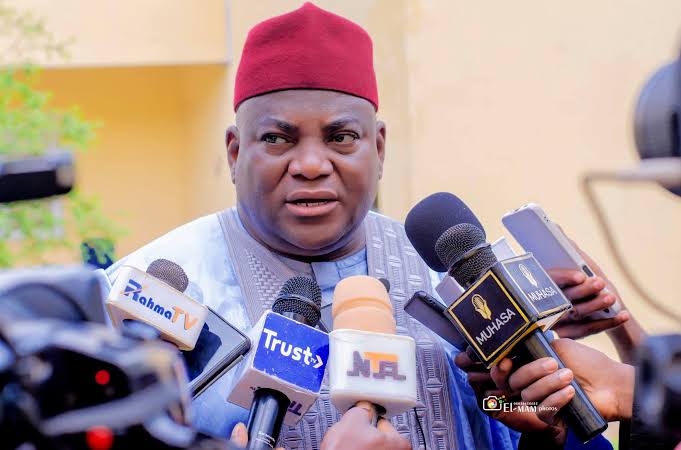
Comrade Waiya: The Man Shaping The Narrative Of Kano First Agenda
By Comrade Najeeb Nasir Ibrahim
There is a particular kind of public official whose value to a government cannot be measured in project completion rates or budget figures alone. Their most significant contribution is something less tangible but far more consequential: the ability to translate a governor’s vision into a living, breathing public conversation, to take the abstract language of policy and render it in terms that ordinary citizens can understand, trust, and ultimately own. Since his swearing-in on the 6th of January 2025, the Honourable Commissioner for Information and Internal Affairs of Kano State, Comrade Ibrahim Abdullahi Waiya, has demonstrated with increasing clarity that he is precisely this kind of official, and that his presence in Governor Abba Kabir Yusuf’s cabinet is not incidental to the administration’s communication success but central to it.
To appreciate what Waiya has brought to the Ministry of Information, it is necessary to understand what he inherited. Government information ministries across Nigeria have, for too long, operated as little more than glorified press offices, reactive in posture, narrow in scope, and limited in ambition. Their function has been largely defensive: to respond to criticism, manage uncomfortable headlines, and project a positive image of an administration regardless of whether the facts on the ground justified that image.
This model of government communication is, at its core, a model of managed dishonesty, and it has contributed enormously to the collapse of public trust in government institutions across the country.
Waiya arrived at the ministry with a different model in mind. Shaped by years of activism, intellectual engagement, and a genuine commitment to social justice, he understood from the outset that the credibility of government communication depends not on the sophistication of its messaging machinery, but on the alignment between what government says and what government does.
His first and most important contribution to the administration has therefore been to insist on that alignment, to position the Ministry of Information not as a propaganda unit but as a governance instrument, one whose primary purpose is to build and sustain the kind of public trust that makes effective governance possible.
This philosophical reorientation of the ministry’s role is most vividly expressed in his stewardship of the Kano First Initiative, the comprehensive policy and implementation framework for social and institutional reorientation that has rapidly become the defining intellectual project of the Yusuf administration. Where others might have approached this initiative as a communication product to be packaged and promoted, Waiya approached it as a covenant between government and citizens, a serious, evidence-based commitment to the restoration of the values, trust, and social cohesion on which Kano’s future depends. Under his intellectual leadership, the Kano First Agenda has been transformed from a political slogan into a governing philosophy, one that integrates Islamic ethical traditions, Kano’s own sociocultural heritage, and the modern science of behavioral change into a single, coherent framework for societal renewal.
What sets Waiya apart from the generality of government communicators is not merely his intellectual depth, significant as that is. It is the combination of that depth with a rare political courage, the willingness to engage publicly and directly with difficult questions, uncomfortable truths, and coordinated misinformation, without retreating into the vague reassurances and carefully hedged non-answers that characterize too much of official communication in this country.
His media appearances, public lectures, and grassroots engagements are marked by a clarity and conviction that comes from someone who has done the thinking, understands the policy, and genuinely believes in the administration’s direction. That combination of preparation and belief is, in the world of public communication, extraordinarily difficult to fake and extraordinarily powerful when it is authentic.
The trust that Governor Yusuf reposes in his commissioner is not, therefore, the blind loyalty of a political patron rewarding a supporter. It is the considered confidence of a chief executive in a strategist who has earned that confidence through consistent performance, sound judgment, and a demonstrated ability to navigate complex communication challenges without compromising either the administration’s message or its integrity. Waiya understands the governor’s vision at a level of depth that enables him to communicate it not merely accurately but compellingly, and to defend it not merely loyally but persuasively. That is a rare and valuable combination.
His impact on the administration’s engagement with youth, civil society, and intellectual circles deserves particular mention. One of the most persistent failures of Nigerian state governance has been the alienation of educated, critically minded citizens from the business of government, an alienation that feeds cynicism, drains civic energy, and ultimately weakens the social fabric that development depends upon.
Waiya has worked deliberately and consistently to reverse this trend in Kano, reaching out to universities, engaging with professional associations, cultivating relationships with media institutions, and creating spaces where citizens are invited not merely to receive government information but to participate in the conversation about Kano’s direction. This approach to civic engagement is not cosmetic. It is substantive, and its effects are already visible in the quality of public discourse around the administration’s policies.
Perhaps his most enduring contribution, however, is his work on societal reorientation, the understanding that sustainable development in Kano requires not only better policies and more resources but a genuine shift in civic culture, in how citizens relate to their institutions, to one another, and to the responsibilities of community membership. Through consistent messaging on discipline, social responsibility, the dignity of productive labor, and the importance of active citizen participation in governance, Waiya has cultivated what might be described as a new civic consciousness in Kano, an emerging public awareness that the state’s progress is not the government’s gift to the people but the people’s collective achievement, enabled by government but ultimately owned by citizens.
None of this work is easy, and none of it is without risk. A commissioner who speaks plainly, engages critically, and insists on the alignment between words and deeds will inevitably attract the hostility of those who prefer the comfortable opacity of conventional government communication. The honorific that has attached itself to Waiya in informed circles, the Super Commissioner, is therefore not merely a compliment. It is a recognition that he has chosen a harder, more demanding, and ultimately more honorable path than the one most available to him, and that he has walked it with the consistency and conviction that genuine public service requires.
As the Kano First Initiative moves from its foundational phase into the intensive engagement and behavioral activation that will define its impact, the role of the man who gave it its intellectual spine and its institutional credibility becomes ever more critical. The initiative will face resistance, as all serious reform efforts do. It will encounter the skepticism of those who have been promised change before and received disappointment. It will be tested by resource constraints, political pressures, and the inevitable gap between ambitious vision and complex reality. In those moments of testing, the quality of leadership that Comrade Ibrahim Abdullahi Waiya has demonstrated since January 2025 will matter enormously.
Kano has had commissioners who managed their ministries competently. It has had commissioners who communicated their administrations effectively. It has had, occasionally, commissioners who thought seriously about their portfolios. What it has rarely had is a commissioner who does all three simultaneously, and who brings to that combination the moral seriousness, intellectual depth, and personal courage that the moment genuinely demands. In Comrade Ibrahim Abdullahi Waiya, Kano State has that commissioner now.
The Kano First Initiative is, in no small measure, his gift to the state. The least that the state owes him in return is the seriousness of its full engagement with the agenda he has worked so tirelessly to bring to life.
Comrade Najeeb Nasir Ibrahim is a Public Affairs Analyst