

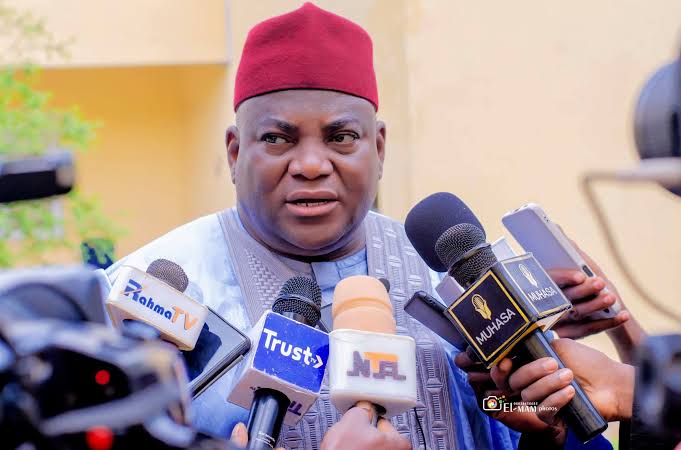
The Architect Of Renewal: How Comrade Ibrahim Abdullahi Waiya Is Quietly Rewriting Kano’s Governance Story
By Munir I. Publisher
In the long and often turbulent history of Nigerian governance, it has become almost axiomatic that the most visible actors attract the most attention. Governors cut ribbons. Politicians make speeches. Press releases are issued, photographs are taken, and the machinery of public perception grinds steadily forward. Yet history, when it takes the longer and more honest view, consistently reminds us that the men and women who shape the intellectual direction of governance are rarely the ones occupying the most prominent positions on the podium.
They are, more often, the ones working in the spaces between spectacle and substance, translating vision into doctrine, converting political ambition into civic philosophy, and doing the painstaking, unglamorous work of building ideas that outlast the administrations that gave birth to them.
In Kano State today, that figure is the Honourable Commissioner for Information and Internal Affairs, Comrade Ibrahim Abdullahi Waiya. His name has become inseparable from the Kano First Initiative, the most intellectually serious and socially ambitious governance commitment that the state has undertaken in recent memory.
And the reason his name has become inseparable from it is not because he was assigned to communicate it, but because he understood it, believed in it, and worked with a consistency and conviction that gradually transformed a political vision into an emerging civic philosophy. In the circles where Kano’s governance trajectory is seriously discussed, the honorific that has attached itself to him, Limamin Kano First, is not merely a title. It is a recognition of intellectual authorship.
To appreciate the significance of what Waiya has contributed, one must first appreciate the nature of the challenge that the Kano First Initiative was designed to address. Kano is not simply a state facing the familiar Nigerian difficulties of infrastructure deficit and economic underdevelopment, serious and pressing as those challenges are.
Kano is a state facing a deeper and more difficult crisis: the erosion of the normative foundations on which its historical greatness was built. The values of integrity, communal responsibility, respect for legitimate authority, the dignity of productive labor, and the centrality of knowledge and ethical conduct in public life, these are not abstract ideals. They were, for generations, the operational principles of a civilization that made Kano one of the most enduring and consequential societies in West Africa. Their erosion, accumulated over decades of misgovernance, institutional decay, and cultural dislocation, is the real crisis that the Kano First Initiative was conceived to address.
Waiya understood this with a clarity that preceded his appointment as commissioner. Long before he assumed public office, he was a figure of significance in Kano’s civic landscape, an activist, an advocate, and an intellectual voice whose engagement with questions of democratic governance, youth mobilization, and civic participation gave him a perspective on the state’s challenges that was both grounded and searching. When Governor Abba Kabir Yusuf brought him into the cabinet, he brought with him not merely professional competence but a formed worldview, a coherent and deeply held set of convictions about what genuine governance requires and what genuine communication must achieve. It is this worldview, rather than any particular communication technique or media strategy, that has defined his tenure and shaped his contribution.
The most consequential of those contributions has been the deliberate reframing of the Kano First Initiative from a political programme into a civic philosophy. This distinction is not semantic. Across Nigeria, government programmes are born and buried with the administrations that created them, because they are understood, by citizens and by the political class alike, as belonging to a particular governor or a particular party rather than to the society they were ostensibly designed to serve.
This cycle of programmatic discontinuity is one of the most destructive features of Nigerian governance, and it has robbed successive generations of citizens of the cumulative benefits of sustained policy commitment. By consistently and insistently framing Kano First as a shared civic responsibility, as a covenant between government and citizens that transcends electoral cycles and partisan boundaries, Waiya has worked to break that cycle. He has sought to anchor the initiative in Kano’s identity rather than in any single administration’s political fortunes, and in doing so, he has given it the best possible chance of surviving beyond the immediate political moment.
His approach to the ministry itself reflects the same philosophical seriousness. The conventional Nigerian information ministry is, at its most functional, a reactive institution, designed to manage the government’s image, respond to unfavorable coverage, and project official narratives through the available media channels. Waiya has operated from a fundamentally different premise: that the Ministry of Information, properly understood, is a governance institution whose primary function is not the management of perception but the cultivation of civic understanding.
Under his stewardship, government communication has been repositioned as a form of public education, an ongoing effort to help citizens understand not merely what the government is doing but why it is doing it, what values and principles underpin its decisions, and what role citizens themselves are expected to play in the shared project of Kano’s development.
The practical expression of this philosophy has been visible in the quality and consistency of his public engagements. Whether addressing media briefings, participating in policy forums, engaging with youth organizations, or reaching out to traditional and religious institutions, Waiya’s communication has been characterized by a disciplined fidelity to a small number of core ideas: that Kano’s interests must always take precedence over narrow personal or political considerations, that development requires not just government investment but citizen responsibility, that institutional trust must be earned through alignment between words and deeds, and that the renewal of Kano’s civic culture is a generational project that demands patience, consistency, and collective commitment. These are not talking points. They are convictions, and their authenticity is precisely what has given them traction in a public environment deeply habituated to the difference between what officials say and what they mean.
For Governor Abba Kabir Yusuf, whose administration has committed itself to a range of developmental initiatives spanning infrastructure, education, economic empowerment, and social welfare, the Kano First philosophy provides what every serious governance agenda requires but few administrations are fortunate enough to have: a coherent intellectual framework through which individual policies can be understood as part of a larger and purposeful whole.
The governor’s political authority and executive commitment drive the policy agenda. Waiya’s intellectual contribution gives that agenda a narrative architecture, a set of ideas and values that makes the administration’s work legible and meaningful to citizens who might otherwise see only a collection of disconnected projects and announcements.
This is the work that rarely generates headlines but frequently determines outcomes. The construction of a governance doctrine, the patient, persistent effort to embed a set of principles deeply enough in a society’s public life that they begin to shape how institutions behave and how citizens engage with those institutions, is among the most difficult and most important contributions that any public official can make. It requires intellectual seriousness, communicative skill, personal conviction, and a willingness to do work whose rewards are deferred and whose recognition is uncertain. Waiya has brought all of these qualities to his role, and the emerging resonance of the Kano First philosophy in the state’s public discourse is the clearest evidence of their impact.
The road ahead is neither short nor smooth. For the Kano First Initiative to achieve the transformative impact its architects intend, its principles must travel far beyond the walls of government ministries and into the daily life of the state, into its markets and mosques, its schools and community associations, its media houses and professional organizations, its youth networks and women’s groups. Every institution and every individual that engages seriously with the initiative’s values adds to the momentum of renewal. Every act of civic responsibility, every demonstration of institutional integrity, every young person who chooses productive enterprise over destructive shortcuts, is a small but real vindication of the philosophy that Waiya has championed.
Ideas, when they are genuinely good and genuinely held, have a way of outlasting the circumstances of their birth. The Kano First Initiative is still in its formative stages, and its ultimate legacy will be written by the quality of its implementation and the depth of its public embrace. But the intellectual foundation has been laid with seriousness and care, and the man who has done more than any other to lay it deserves the recognition that serious public service demands. History will record, when it takes the full and honest measure of this moment in Kano’s governance journey, that one of the most consequential contributions to the state’s renewal came not from the most visible podium, but from the disciplined, purposeful, and deeply committed work of Comrade Ibrahim Abdullahi Waiya, the Architect of Renewal, and the enduring voice of Kano First.
Munir I. Publisher is a governance analyst and public affairs commentator based in Kano State.