


By Abbas Ibrahim
There are places we work, and there are places that become part of who we are. For me, Radio Kano is both.
Thirty eight years ago, destiny brought me to the defunct Kano Broadcasting Corporation as a young reporter. Radio Kano was then 42 years old. Today, as it celebrates 80 years, I cannot reflect on my professional journey without remembering the institution that shaped my life.
I still remember the interview panel led by the late Managing Director, Alhaji Hassan Suleiman. Four years earlier, I had graduated from the School of Social and Rural Development, Rano, with a Diploma in Community Development and Adult Education. I never planned to become a journalist. Destiny made me a newsman.
My first Director of News and Current Affairs, Mr Hussaini Tabci, introduced me to the Head of the Reportorial Unit, Alhaji Abdulhamid Adamu Majiya, who taught me newsroom culture. My first assignment was transcribing news from national and foreign radio stations. It was demanding, but those early struggles became part of my training. Afterwards, I was sent to FRCN training school, Shogunle, Lagos for basic rudiments of the work. I later attended several courses including those on investigative reporting.
Radio Kano taught me that journalism requires discipline, accuracy, responsibility and service to society.
I later joined experienced reporters on assignments, including a trip to Birnin Kudu before the creation of Jigawa State, with Hajiya Habiba Ndatsu Umaru, wife of the then Military Governor, Group Captain Ndatsu Umaru,under the Better Life for Rural Women programme.
One of my greatest mentors was Aminu Sa’adu Beli, I was attached to him during the trip and on our way back , around the present Police Academy, Wudil, a tipper from the opposite direction ran into our convoy, where a driver and a woman we earlier had conversation with at Gwaram during the program died on the spot. Aminu Beli’s enduring lesson was simple, “Always strive to live an honest life”. That lesson remains with me.
Crime and judiciary reporting changed my understanding of journalism. Following cases from investigation and arrest through prosecution and judgment exposed me to the realities of crime, victims, families and the responsibilities of investigators, lawyers and judges.
One experience remains permanently sticked to my memory. I interviewed the first woman, alongside her son, who were publicly executed by firing squad after conviction by the Armed Robbery and Firearms Tribunal for armed Robbery and Murder at the Kano Race Course. I had followed the case from arrest to prosecution and interviewed her shortly before the execution.
As the bullets were fired, I could not hold back my tears. That moment reminded me that journalism is not only about reporting events, sometimes, the journalist becomes a witness to history. For many of us, Radio Kano was a school without walls.
It trained reporters, producers, presenters, editors, technicians and broadcasters who contributed significantly to Nigeria’s media industry. Its professionalism and discipline shaped generations of media practitioners.
I remember the short-lived Farm Radio, established to promote Kano’s agricultural potential, and Taskar Labarai, the magazine programme initiated by the late Sule Magaji Bello, which became a strong bridge between the station and its audience, attracting listeners from neighbouring states and beyond.
Radio Kano’s greatest strength has always been its ability to reach people other forms of communication may not reach. It informed, educated, entertained and mobilised communities, connecting government with citizens and citizens with one another.
For generations of Kano people, radio was more than an object in the home. It was a companion in homes, farms, markets, offices and villages.
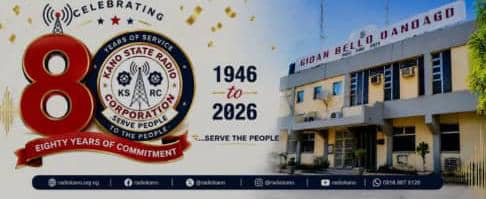
As Radio Kano celebrates 80 years, with Comrade Adamu Rano as its 21st Managing Director and veteran broadcaster Abdulkadir Ahmed Ibrahim leading the anniversary committee, the celebration should look beyond the past
Radio Kano has history. It has experience. It has a loyal audience. It has institutional memory and, importantly, it has the potential to remain one of Kano’s most powerful instruments for education, development, culture and social cohesion.
The 80th anniversary should therefore mark not the end of an era, but the beginning of a new chapter,Radio Kano renewed, better equipped, digitally connected and firmly rooted in the people it was established to serve.
For many of us, our personal histories are tied to Radio Kano. It gave us opportunities, mentors, lifelong friends and a deeper understanding of society. In my case, it transformed a community development officer into a newsman.
The story of Radio Kano is therefore not only about transmitters, studios, programmes and management. It is about people, the broadcasters, reporters, technicians, mentors and generations of listeners whose lives were touched by the station.
As Radio Kano turns 80, let us celebrate its legacy while strengthening its future.
Radio Kano has been Kano’s voice for 80 years. May that voice continue to inform, educate, unite and inspire generations yet unborn.
Happy 80th Anniversary, Radio Kano.
Uwa ma bada Mama!
Abbas Ibrahim can be reached @ abbasibrahim664@gmail.com


