


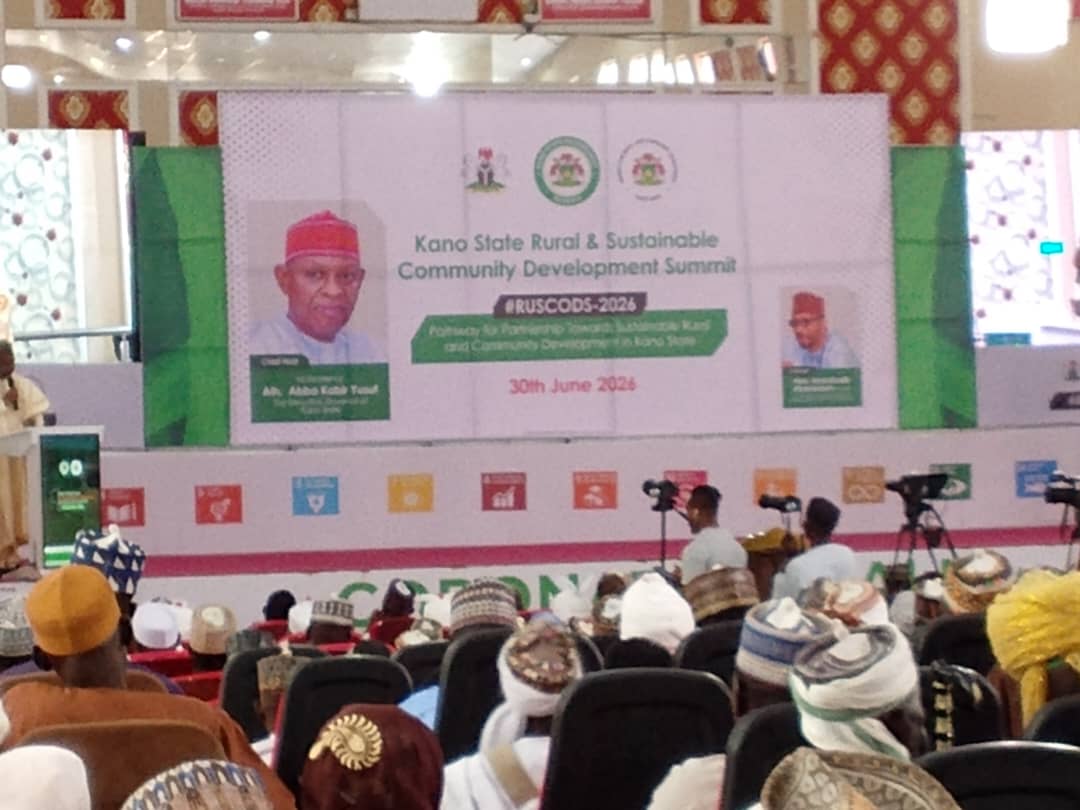
Gov. Yusuf Identifies Unemployment, Insecurity, Poor Infrastructure As Major Challenges To Rural Development
By Abdullahi Yusuf
Governor Abba Kabir Yusuf of Kano State has identified unemployment, insecurity, inadequate infrastructure, poor access to quality healthcare and education as major challenges to rural development in the state.
Yusuf also listed climate-related challenges,inadequate water and sanitation facilities as the other challenges facing rural development in the state.
He made the remarks at the Kano State Rural and Community Development Summit held at the Government House,on Tuesday.
Represented by his Deputy, Alhaji Murtala Sule Garo, the governor reaffirmed his administration’s commitment to accelerating rural development through stronger partnerships with development agencies, the private sector, Civil Society Organisations(CSOs) and local communities.
He said the administration remains determined to ensure that no community is left behind in the state’s development agenda, stressing that rural and community development is central to Kano’s vision for inclusive economic growth, social progress and environmental sustainability.
He commended the organisers of the summit and the Ministry of Rural and Community Development for bringing together key stakeholders to deliberate on issues affecting rural communities.
“The prosperity of Kano State is closely linked to the strength, productivity and enterprise of our rural communities where agriculture, commerce and small-scale businesses continue to sustain livelihoods and contribute significantly to our economy,” he said.
Yusuf also noted that his government had anchored its policies on fairness, accountability, transparency and responsive leadership, with the welfare of citizens at the heart of governance.
He, however, stressed that government alone could not address the numerous challenges confronting rural communities,and called for sustained collaboration among development partners, financial institutions, civil society organisations, traditional and religious institutions, women and youth groups, academic institutions and the private sector.
According to him, the summit offers stakeholders an opportunity to exchange ideas, strengthen partnerships and develop practical solutions that will improve living standards across rural communities.
Highlighting government interventions, the governor said his administration had prioritised the construction and rehabilitation of rural roads, expansion of potable water supply, rural electrification and programmes aimed at boosting economic activities.
He said investments had also been made in primary healthcare, school infrastructure, teacher development and increased school enrolment to improve access to essential services.
He further stated that agriculture, which remains the backbone of the rural economy, continues to receive government support through improved extension services, expanded irrigation schemes, access to quality farm inputs and initiatives designed to strengthen agricultural value chains.
He reaffirmed the government’s commitment to empowering women and youths through skills acquisition, entrepreneurship programmes and improved access to finance, while promoting climate-smart agriculture, tree planting and sustainable natural resource management.
Yusuf urged development partners to deepen collaboration with the state government and encouraged the private sector to invest in agriculture, renewable energy, digital inclusion and job creation.
In his address,the Commissioner for Rural and Community Development, Alhaji Abdulkadir Abdulsalam, unveiled a five-year Strategic Framework for Integrated Rural and Sustainable Community Development (2026–2030), aimed at reducing rural poverty by 40 per cent by 2030 through data-driven planning, improved infrastructure and enhanced service delivery in the state.
Abdulsalam described the framework as the first comprehensive blueprint to harmonise development efforts across the 44 local government areas and 484 wards in the state.
He said the strategy was developed following extensive field research involving more than 300 communities and 9,000 households across the state’s 36 rural local government areas.
According to him, the framework aligns with nine of the 17 United Nations Sustainable Development Goals and focuses on critical sectors including healthcare, education, agriculture, rural infrastructure, water, sanitation and hygiene, rural roads, governance, social protection, security and climate resilience.
The commissioner said implementation of the framework would commence with institutional strengthening and baseline studies in 2026, followed by quick-impact projects in 2027, expansion of infrastructure by 2029 and consolidation of community ownership by 2030.
He disclosed that the programme would be financed through state and local government budgets, federal interventions, donor agencies, philanthropic organisations and community contributions, stressing that the framework was designed to avoid additional borrowing.


