By Comrade Abbas Ibrahim
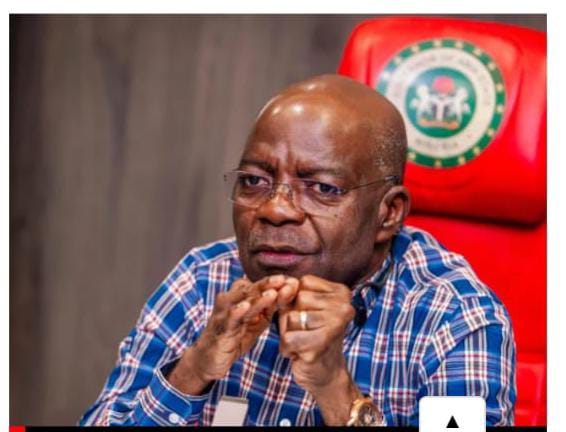
Governor Alex Otti of Abia State has once again demonstrated that, in politics, standing alone can sometimes be more powerful than moving with the crowd.
His recent reaction to claims by Imo State Governor Hope Uzodimma that all five South-East governors had agreed to support President Bola Ahmed Tinubu for a second term in 2027 has injected a rare dose of political clarity into an unpredictable political environment.
Otti’s position was unambiguous, while Governor Uzodimma had every right to express his personal opinion, he could not speak for every governor in the South-East.
That statement, coming from the only serving governor elected on the platform of the Labour Party, is significant. At a time when political defections and alignments have become a dominant feature of Nigeria’s political landscape, Governor Otti has chosen to remain within the political family that declaration of hostility towards President Tinubu. Indeed, Otti made it clear that he was not opposed to the President seeking a second term.
“Am I against the President running for a second term? Absolutely no. He has a right to run for a second term, and others who also want to run have a right to run,” he said.
But the governor also made another point that goes to the heart of democratic politics, his party has its own candidates.
“My party is Labour Party. And Labour Party has its own presidential and vice presidential candidate. To the extent that we have candidates, we support them,” he stated.
This is the essence of political pluralism. Democracy is not merely about the number of politicians supporting the ruling party. It is also about the existence of credible alternatives.
The Courage to Stand Apart
Governor Otti’s decision to remain with the Labour Party has made him an interesting political figure in the build up to 2027. While political calculations are constantly changing and politicians are free to make decisions based on their convictions and interests, the growing movement towards the ruling party has raised important questions about the future of opposition politics in Nigeria.
When almost every political road appears to be leading in one direction, the few who choose to remain on the other side of the political divide acquire a special responsibility.
Governor Otti has, by his position, demonstrated that political loyalty and independent thinking can still exist in Nigerian politics.
His position has also added colour and credibility to the present political climate.
A ruling party without a credible challenge may become less responsive to the people. On the other hand, a government that knows it must face a competitive election is more likely to remain conscious of public opinion and the consequences of failure.
This is why the survival of the Labour Party as a credible national opposition platform is important not only for its members but for Nigeria’s democracy.
The Labour Party may currently be facing internal challenges, but the emergence of the Senator Nenadi Usman led National Executive has provided renewed hope,(Not APC’s) for the party’s reconciliation and reorganisation.
More importantly, the Labour Party still possesses a nationwide political structure spread across the 774 local government areas of the country. That structure, if properly mobilised, strengthened and democratically managed, could become a significant platform ahead of 2027.
existing structure into an effective political machinery capable of reaching Nigerians at the grassroots.
Nigerian politics has become sophisticated in the packaging and repackaging of political narratives.
But no amount of packaging can permanently conceal failure.
At the same time, competence cannot be permanently hidden. Where a government performs, citizens will eventually notice. Where it fails, no amount of political propaganda can forever conceal the consequences.
The ultimate judge remains the Nigerian people.
That is why Governor Otti’s emphasis on the ballot box is important. The decision on who becomes president in 2027 should not be determined by political declarations made by governors, party leaders or powerful individuals.
It should ultimately be decided by the Nigerian people.
Governor Alex Otti’s position has provided an important reminder that democracy is strengthened when political actors are willing to stand by their convictions.
His refusal to simply follow the political bandwagon has given the Labour Party a voice at a time when the opposition space appears increasingly vulnerable.
But the responsibility does not rest on Otti alone.
The Labour Party must now prove that it can rise above internal disputes, rebuild its structures and fight for the Nigerian people.
It must not be deterred by political manipulation, defections or the apparent dominance of the ruling party.
The party has a national structure. It has a political identity. It has a history of national relevance. It also has millions of Nigerians who are still searching for a credible alternative.
What is required now is courage, organisation, unity and a clear message.
Because, ultimately, political reality cannot be permanently manipulated.
Failure will remain visible, no matter how beautifully it is packaged and repackaged.
And competence, where it exists, will continue to speak for itself.
The 2027 election should therefore not be reduced to a contest of political defections or the strength of the ruling party’s machinery. It should be a contest of ideas, performance, credibility and the ability to convince Nigerians that their votes can still produce meaningful change.
Comrade Ibrahim writes from Kano and can be reached at abbasibrahim664@gmail.com