


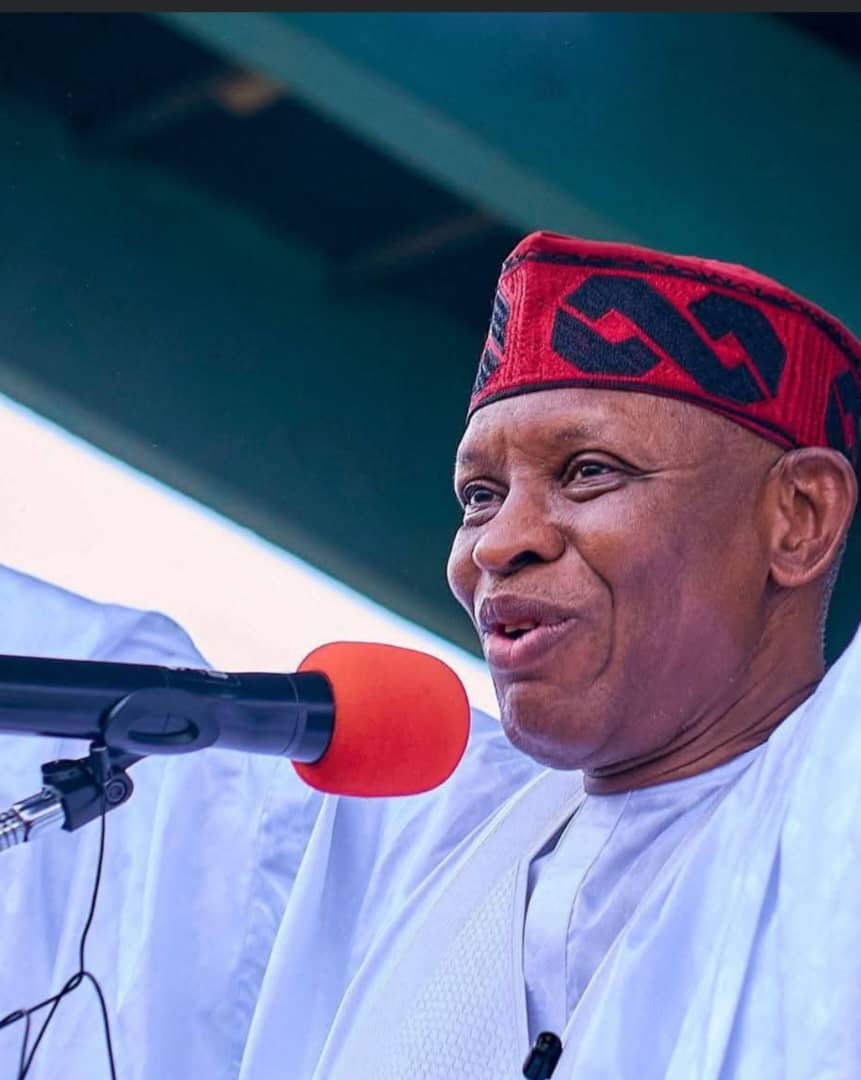
By Hafiz Garba PhD,
In the long and complicated history of Nigerian governance, awards have too often been the currency of flattery rather than the fruit of performance. They have been given to the powerful because they are powerful, to the wealthy because they are wealthy, and to the politically connected because connection is its own reward in a system where accountability is frequently optional and excellence is rarely demanded. It is against that deeply ingrained culture of performative recognition that the awards record accumulated by Governor Abba Kabir Yusuf of Kano State across three years in office must be understood, because what distinguishes his recognition from the routine distribution of honorary plaques that passes for institutional commendation in too many Nigerian contexts is something specific, something verifiable, and something that the evidence of his governance record makes impossible to dismiss: these awards were earned.
They were earned in classrooms across 44 local government areas where children are learning in renovated buildings for the first time in years. They were earned in hospitals where emergency response vehicles now arrive at night when they previously did not exist. They were earned on roads that connect communities that were previously isolated, in boreholes that draw clean water from ground that was previously untapped, in solar streetlights that illuminate neighbourhoods that were previously dark, and in the accounts of 6,680 women entrepreneurs who received monthly empowerment stipends that changed the material conditions of their lives and the lives of their families. The awards are not the story. They are the world’s response to the story. And the story is three years of governance that has genuinely, measurably, and consistently put the people of Kano State first.
The awards began arriving early and have not stopped. Vanguard Newspaper named Governor Yusuf its Governor of the Year 2024 for Good Governance, citing the administration’s comprehensive approach to development and its demonstrated commitment to transparency and service delivery. Leadership Newspaper, one of Nigeria’s most respected national dailies, named him Governor of the Year 2024 for Education, specifically recognising the historic declaration of a state of emergency in the education sector and the extraordinary commitment of 30 percent of the state’s annual budget, the highest education budget share of any state in Nigeria, to the transformation of a system that had been in visible decline for years. The Nigerian Medical Association presented him with the Best Governor of the Year award, citing his administration’s substantial investments in primary healthcare, hospital renovation, drug supply, and the Abba Care health insurance scheme. The Daily News Agency named him Authentic Humanitarian Governor 2024, recognising the human dimension of a governance philosophy that has consistently prioritised the welfare of the most vulnerable members of Kano’s society over every other consideration.
The Africa Housing Awards presented Governor Yusuf with the Housing and Infrastructure-Friendly Governor of the Year recognition, with organisers describing him as the people’s governor and specifically citing his commitment to inclusive housing, urban renewal, and openness to innovative construction solutions that make quality housing accessible to ordinary citizens rather than merely to the economically privileged. The CREED Magazine Governor of the Year 2025 on Infrastructure and Good Governance added continental weight to a domestic recognition record that was already remarkable, acknowledging the scope and the ambition of an infrastructure investment programme that has reshaped Kano’s physical landscape across three years with a comprehensiveness that few Nigerian state administrations have matched.
And then came Casablanca. At the 14th African Leadership Magazine Persons of the Year Awards ceremony in Morocco, Governor Abba Kabir Yusuf was named African Governor of the Year for Good Governance, an honour bestowed at a gathering of distinguished African leaders, statesmen, and institutional figures, at which he was recognised alongside Dr. Ngozi Okonjo-Iweala, Director-General of the World Trade Organisation, and other continental luminaries whose careers have shaped the governance and development landscape of Africa. The award was presented by the President of Ghana, one of West Africa’s most respected democratic leaders, in a moment that placed Kano State’s governance record on an explicitly continental platform and communicated to an international audience that what Governor Yusuf has been building in the ancient commercial city of northern Nigeria is not merely of local or national significance but of the kind of quality and consequence that the African continent recognises and celebrates.
That moment in Casablanca deserves to be understood in its full historical context. Kano State has a five-century history as one of Africa’s great commercial and intellectual centres, a history that includes its role as the terminal point of trans-Saharan trade routes connecting sub-Saharan Africa to the Mediterranean world, its tradition of Islamic scholarship, and its position as the commercial capital of Northern Nigeria. For its governor to be recognised as the African Governor of the Year for Good Governance at a continental awards ceremony in Morocco is, in one sense, the most modern expression of a very old truth: that Kano’s significance extends beyond Nigeria, that its leaders carry responsibilities not merely to their immediate constituents but to a broader story of northern Nigerian achievement that the continent watches and respects. Governor Yusuf’s Casablanca recognition is not an anomaly in Kano’s history. It is a continuation of it.
What makes the awards record particularly significant from a governance analysis perspective is not merely its volume but its diversity. The recognitions have come from national newspapers, medical associations, housing organisations, infrastructure monitoring bodies, and continental leadership platforms. They have been granted by institutions with different mandates, different evaluation criteria, different political affiliations, and different institutional interests. None of them had any obligation to recognise Governor Yusuf. None of them had anything to gain from doing so beyond the credibility of having identified genuine excellence when it was present. The fact that institutions as different as the Nigerian Medical Association, the Africa Housing Awards, and the African Leadership Magazine have independently arrived at the same conclusion, namely that Abba Kabir Yusuf is governing Kano State with an unusual quality and commitment, is not a coincidence. It is a convergent verdict produced by the consistent application of different assessment criteria to the same governance reality.
As Kano marks its third anniversary on May 29, 2026, those awards line the walls of achievement not as decorations but as a documented, independently verified, and institutionally diverse record of a performance that has been seen, assessed, and recognised by the world beyond Kano’s borders. They are the external confirmation of what the people inside those borders already know from their daily experience: that they have a governor who came to office with a genuine commitment to their welfare, invested in it consistently across three difficult and turbulent years, and delivered outcomes that the most demanding and the most credible evaluators in Nigeria and across Africa have found worthy of the highest recognition available to them.
The world has applauded. And Kano, on its third anniversary, has every reason to stand and join in.


