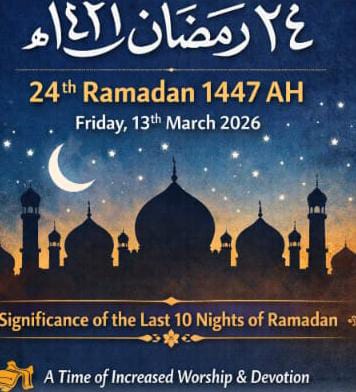
The last ten days of Ramadan are considered the most sacred and spiritually powerful period of the entire month. Muslims increase their devotion because these days offer unique opportunities for forgiveness, mercy, and closeness to Allah. Here are the main values and significance:
1. Seeking the Night of Power (Laylat al-Qadr)
The greatest value of the last ten nights is the search for Laylat al-Qadr.
It is the night when the Qur’an was first revealed to Prophet Muhammad.
The Qur’an describes it as “better than a thousand months.”
Worship done on this night brings rewards greater than worship done for over 83 years.
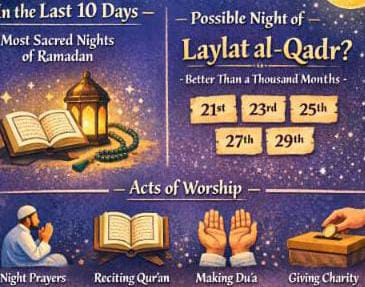
Because its exact date is not known, Muslims intensify worship during the odd nights (21st, 23rd, 25th, 27th, and 29th).
2. Increased Forgiveness and Mercy
These days are a special opportunity for sins to be forgiven. Muslims increase:
Supplication (du’a)
Repentance
Seeking Allah’s mercy
Many scholars say Allah’s mercy and forgiveness are especially abundant during these nights.
3. Intensifying Worship
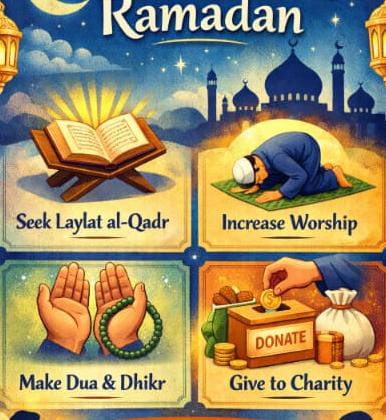
During the last ten days, Muslims try to increase acts of devotion, such as:
Night prayers (Qiyam / Tahajjud)
Recitation of the Qur’an
Dhikr (remembrance of Allah)
Charity and helping others
The goal is to finish Ramadan spiritually stronger than when it began.
4. Practice of Spiritual Retreat (I’tikaf)
Many Muslims observe I’tikaf, staying in the mosque for the last ten days focusing only on worship, reflection, and prayer.
This practice was regularly observed by Prophet Muhammad.
5. Spiritual Transformation
The last ten days are meant to strengthen faith (Iman) and develop Taqwa, which is the ultimate goal of Ramadan.
They encourage believers to:
Reflect on their lives
Renew their relationship with Allah
Make sincere intentions to improve after Ramadan.
✅ In simple terms:
The last ten days of Ramadan are a spiritual climax—a time when Muslims seek maximum reward, forgiveness, and closeness to Allah, especially by striving to catch Laylat al-Qadr.
Related Posts